

Teaching Certification at St. Mary’s
For St. Mary’s students aspiring to become teachers, there are a range of options to receive the training and certification they need. Whatever level or subject our students want to teach, there’s a program available to make it a reality.
About the Educator Preparation Program Policies
The St. Mary’s University Educator Preparation Program is committed to maintaining a high-quality, field-based program which adheres to specific laws and rules, generally related to state and federal requirements, set forth by the Texas Education Agency.
Educator Preparation Program (EPP) Complaint Policy Guidelines
Procedure guidelines allows an applicant, candidate, employee or former employee of the Teacher Education Program, a cooperating teacher, mentor or an administrator in a school district, charter school or private school to submit a complaint about the Teacher Education Program for investigation and resolution in a timely and effective manner.
EPP Performance and Program Accountability
In accordance with Texas Education Code (TEC) § 21.0452 (Consumer Information about Educator Preparation Program), below are the pedagogy and professional responsibilities (PPR) EC-12 certification exam pass rates for St. Mary’s University teacher candidates in the past five years:
| Academic Year | PPR Passing Rate First 2 Attempts | PPR Passing Rate 3+ Attempts | Number of Candidates Tested |
|---|---|---|---|
| 2025-2026 | 100% | 100% | 3 |
| 2024-2025 | 89% | 100% | 10 |
| 2023-2024 | 100% | 100% | 18 |
| 2022-2023 | 95% | 100% | 23 |
| 2021-2022 | 100% | 100% | 24 |
Source: ASEP Reports
For more information about educator preparation programs in Texas please visit the Texas Education Agency site for Consumer Information about Educator Preparation Programs.
Supply and Demand of Texas Teachers
In San Antonio and across Texas, educator supply is not keeping pace with demand, especially in high-need areas such as special education, bilingual/ESL, mathematics and science. Recent state data show that teacher attrition rates have hovered around 12–13% annually, while the number of newly certified teachers has not fully offset these losses.
In Bexar County, districts report persistent vacancies in bilingual and STEM positions, leading to increased reliance on alternatively certified teachers and out-of-field assignments. For Educator Preparation Programs in San Antonio, aligning recruitment and training with these shortage areas is critical to meeting workforce needs.
Criminal History Acknowledgment
Pursuant to the TEC, §22.0835, candidates must undergo a criminal history background check prior to clinical teaching. Pursuant to the Texas Education Code (TEC), §22.083, candidates must undergo a criminal history background check prior to employment as an educator. If you were convicted of an offense that is not considered appropriate for an educator, you could be ineligible to earn certification in Texas.
The Texas Education Agency provides candidates with an opportunity to conduct a preliminary Criminal History Evaluation. This evaluation is a non-mandatory, non-binding evaluation of an individual’s self-reported criminal history. In addition, the agency obtains your name-based Texas criminal history information. The service is provided to the requester for a non-refundable fee. The requester will receive an evaluation letter by email from agency staff advising of potential ineligibility for educator certification.
Credit for Military Experience
In accordance with 19 TAC §228.35(a)(5)(A), military service members or military veterans may be given credit for certain verified military service, training or education toward the training, education, work experience or related requirements (other than certification examinations) for educator certification requirements, provided that the military service, train or education is directly related to the certificate being sought.
Contact the Education Department for additional information.
Fall 2025 and Spring 2026 Educator Preparation Program and Clinical Teaching/Residency Application Dates
| Date | Event |
|---|---|
| June 12 and June 15, 2026 | Clinical Teaching/Residency Information Session |
| July 3, 2026 | Clinical Teaching/Residency Applications Due |
| July 8, 2026 | Faculty Committee on Teacher Education Meeting |
| July 20, 2026 | Acceptance Letters to the Clinical Teaching/Residency Program Sent to Students |
| Sept. 21, 2026 | Clinical Teaching/Residency Information Session |
| Oct. 5, 2026 | Clinical Teaching/Residency Applications Due |
| Oct. 12, 2026 | Educator Preparation Program Application Window Opens |
| Oct. 15, 2026 | Faculty Committee on Teacher Education Meeting |
| Oct. 23, 2026 | Acceptance Letters to the Clinical Teaching/Residency Program Sent to Students |
| Oct. 24, 2026 | Educator Preparation Program Applications Due |
| Feb. 8, 2026 | Clinical Teaching/Residency Information Session |
| Feb. 22, 2027 | Clinical Teaching/Residency Applications Due |
| March 4, 2027 | Faculty Committee on Teacher Education Meeting |
| March 5, 2027 | Educator Preparation Application Window Opens |
| March 19, 2027 | Educator Preparation Program Applications Due |
| March 22, 2027 | Acceptance Letters to the Clinical Teaching/Residency Program Sent to Students |
View Educator Preparation Program Policies
Undergraduate Programs with Teacher Certifications
As a state-approved Educator Preparation Program (EPP), St. Mary’s University offers undergraduate degrees in a variety of disciplines — from art and history to political science and chemistry — with the option to add on a teacher certification. You can choose from the following bachelor’s degrees with Teacher Certification programs:
- Art Education with Art (EC-12) Certification
- Biology with Life Science (7-12) or Science (4-8) Certification
- Chemistry with Chemistry (7-12) or Physical Science (6-12) Certification
- Communication Studies with Speech (7-12) Certification
- Computer Science with Computer Science (7-12) Certification
- Elementary Education with Core Subjects (EC-6) Certification
- English Language Arts and Reading with English Language Arts and Reading (4-8 or 7-12) Certification
- Environmental Science with Science (4-8) Certification
- Exercise and Sport Science with Physical Education (EC-12) Certification
- History with History (7-12) Certification
- Mathematics with Mathematics (4-8 or 7-12) Certification
- Music – Instrumental with Music (EC-12) Certification
- Music – Vocal with Music (EC-12) Certification
- Political Science with Social Studies (4-8 or 7-12) Certification
- Spanish with Spanish (EC-12) Certification
Procedural Requirements for Teacher Education Students Seeking Teacher Certification
- Meet with the Education Faculty Mentor/Advisor to go over the program corresponding to the teacher certification. Create a student folder with the Education Department.
- Following the degree plan associated with your teacher certification area, start taking courses (start with the university core courses).
- Upon completion of 60 hours of coursework, maintaining a GPA of 2.6 and meeting other requirements listed on the Admission Requirements to the Educator Preparation Program (p. 4 of this handbook), apply to be in the Educator Preparation Program (EPP). Refer to the St. Mary’s Education Department Educator Preparation Program Policies section on this webpage for important EPP application dates.
- Take Education courses and start logging in your pre-service field-based experience hours.
- Apply to do either the year-long residency or the semester-long clinical teaching. The most up-to-date information about deadlines for the residency/clinical teaching application can be found within the important EPP application dates section under Educator Preparation Program Policies on this webpage.
- Successfully complete your residency or clinical teaching.
- Take and pass the teacher certification exams:
- Elementary Education majors — Pedagogy and Professional Responsibilities (PPR) EC-12, Core Subjects EC-12 and the Science of Teaching Reading (STR)
- Other majors — Pedagogy and Professional Responsibilities (PPR) EC-12 and content area exam
- Starting Fall 2026, a teacher candidate participating in a residency shall be eligible for an enhanced standard certificate. If the candidate demonstrates proficiency in each of the educator standards for the assignment and the field supervisor, host teacher and campus supervisor recommend to the EPP for the enhanced standard certificate, the candidate does not have to take the PPR. (19 TAC§228.65)
For more information, please refer to the Educator Preparation Program Handbook (PDF).
Resources
- Admission requirements to the Educator Preparation Program (PDF)
- Clinical Teaching Handbook 2026-2027
- Digital learning opportunities and requirements for teachers (PDF)
- StMU EPP Reciprocity Policy (PDF)
- The Teacher Residency Handbook 2026-2027
View Procedural Requirements for Teacher Education Students Seeking Teacher Certification
Clinical Experiences
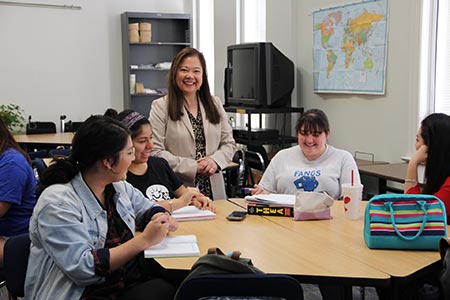
Clinical experience serves as the culminating component of the Educator Preparation Program, providing candidates with supervised opportunities to apply instructional knowledge and professional skills in authentic PK–12 settings.
Candidates complete this requirement through clinical teaching, residency, internship or another SBEC-approved option after meeting all program prerequisites. Placements must occur in approved school settings and include increasing responsibility for planning, instruction, assessment, classroom management and professional practice under the guidance of qualified mentors and field supervisors.
Clinical teaching requires a minimum of 490 hours (455 under approved extenuating circumstances), while residency requires at least 750 hours and 400 instructional hours. Throughout these experiences, candidates are evaluated on their proficiency in the Texas Educator Standards and their readiness for certification and professional practice.
Education Department at St. Mary’s
The St. Mary’s University Department of Education offers minors, bachelor’s degrees and a post-baccalaureate certificate focused on education. Learn more about each option below.

Bachelor of Arts in Elementary Education
This Bachelor of Arts in Elementary Education is designed for those wishing to teach elementary school. Clinical teaching is required.
Minor in Education Studies
This Minor in Education Studies will allow students to gain knowledge and field-based experience in teaching at the elementary, middle or high school level without having to do student teaching and passing the state teacher certification exams, two of the requirements to acquire a Texas teaching certificate.
This minor will qualify students to teach in private schools, including parochial schools.

Post-Baccalaureate Certificate for Teaching in Catholic Schools
This certificate will enable students to gain knowledge and virtual experience in teaching at the elementary, middle or high school level without having to do student-teaching, one of the requirements to acquire a Texas teaching certificate for public schools.
This certificate will qualify students to teach in primary through secondary Catholic schools, but not public schools.
Contact Us
For more information, contact the Chair of the St. Mary’s Department of Education.
Angeli Willson, Ph.D.
Chair of the Department of Education
210-436-3121
awillson@stmarytx.edu