Strengthening Vatican connections
by Nathaniel Miller
The sun was just beginning to rise, and beads of sweat were already rolling down people’s faces. It wasn’t even 8 a.m.
The weather on Aug. 22, 2026, brought typical Texas heat. No clouds brought relief to the crowd of more than 570 people gathered on the St. Mary’s University Flex Field.
But the temperature was no match for the palpable energy the group of students exuberated that Saturday morning. Laughter filled the air. A mixture of pop and Tejano music blared from speakers. Rattler Man photobombed selfies and TV news coverage.
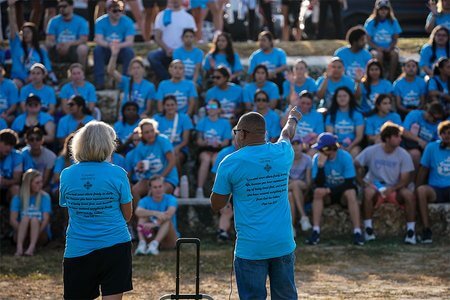
When it was time, everyone found their seats and listened intently as St. Mary’s President Winston Erevelles, Ph.D., gave welcoming remarks, reminding them that what they were about to do was much larger than any one person.
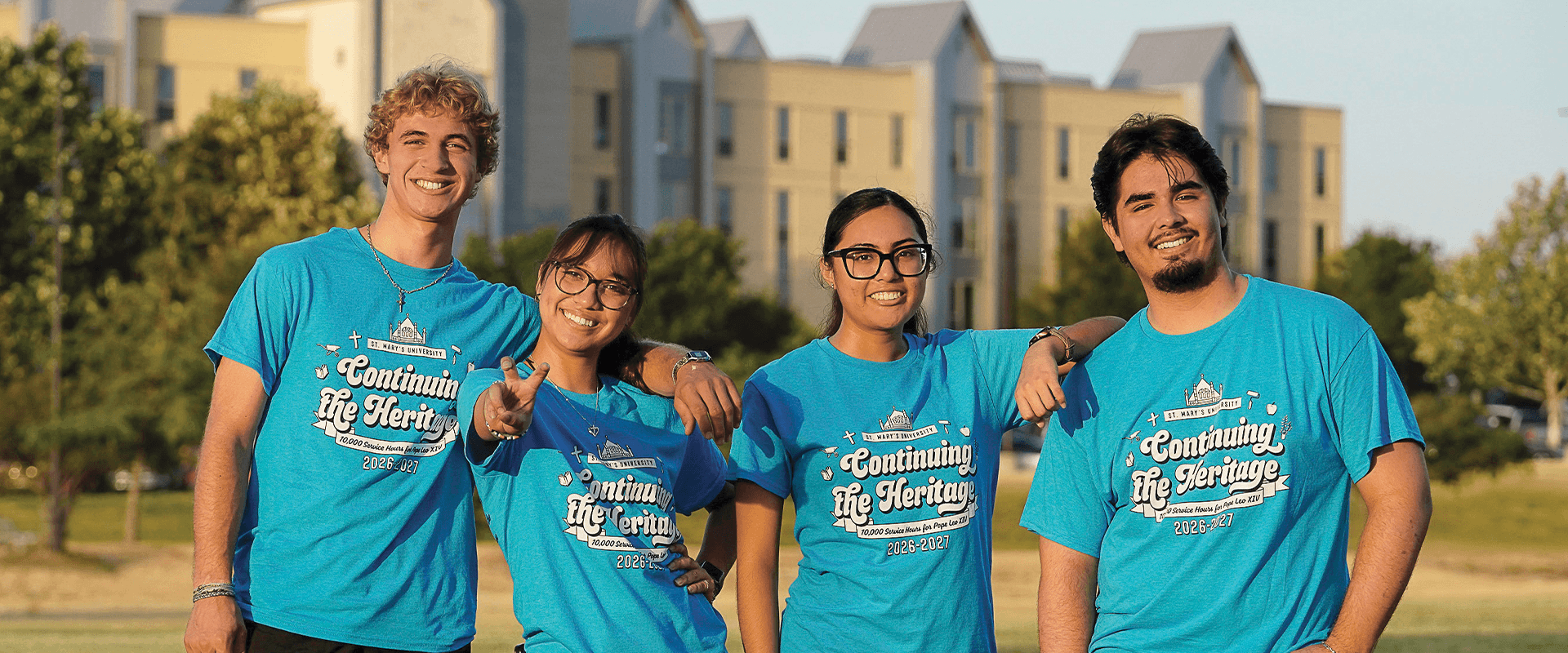
The University-wide initiative, Continuing the Heritage Day of Service, sent faculty, staff, students and alumni across the city to assist dozens of nonprofits. Held at the beginning of the fall semester, the annual event offered an opportunity to practice the Marianist value of servant leadership.
Many volunteered at food banks. Some built houses or beds for those in need. Others helped elementary schools paint walls, repair equipment and clean playgrounds.
For the 2026-2027 academic year, this wasn’t just about giving back; it was also the official kickoff for a special effort to honor Pope Leo XIV.
Inspired by Erevelles’ trip to the Vatican and his meeting with Leo during the summer, the University has pledged 10,000 hours of service in honor of the first American pope.
“The measure of a life well lived is what you give back to others,” Erevelles said to the crowd that morning.
The message of serving others was more than just bringing students closer to the Marianist mission. It also aligns with the pope’s first encyclical, Magnifica Humanitas, Latin for “magnificent humanity.”
Many focused on the encyclical’s language regarding artificial intelligence. However, in the text, Leo explored and reiterated the dignity of the human person in the time of technological advancement.
“We’ve been calling this document the AI document, but it’s not all about AI,” said the Rev. John Thompson, S.M., Ed.D., Vice President of Mission and Rector. “The first line of the encyclical is about the grandeur of humanity, and the first two chapters of the document are about the human person and about Catholic Social Teaching and why that’s important.”
The encyclical affirmed Catholic principles in support of the common good. As part of its mission, St. Mary’s has been quick to respond to the themes of encyclicals now and in the past.
In 2021, St. Mary’s was the first university in Texas to become a Laudato Si’ University and began a seven-year journey to promote a sustainable home. The decision came after the 2015 publication of Pope Francis’ Laudato Si’, on Care for Our Common Home, which calls on people of faith and institutions to see the moral and theological reasons for environmentalism.
St. Mary’s also invests resources into the education and training of its Catholic heritage through retreats and programs, such as the Marianist Leadership Program for students and Marianist Educational Associates for faculty and staff. Students with the Honors Program also make an annual pilgrimage to Rome.
In the moment they began to disperse from the Flex Field, the sea of students, awash in light blue T-shirts, may not have been thinking about the specific meaning of the pope’s encyclical. They had only one thing on their mind: serving their community.
“As students, we have many obligations, but at the same time, we’re citizens, and we have an obligation to come out and help our communities,” said sophomore Software Engineering major Kolby Cruz. “At the end of the day, we’re all people.”
Once-in-a-lifetime meeting
It was the third time Erevelles has visited Rome and the Vatican. It was the first time he met a pope.
The man whose words bring comfort and guidance to more than a billion Catholics — many of whom travel thousands of miles to get even slight glimpses from a distance — was a handshake away from the St. Mary’s president.
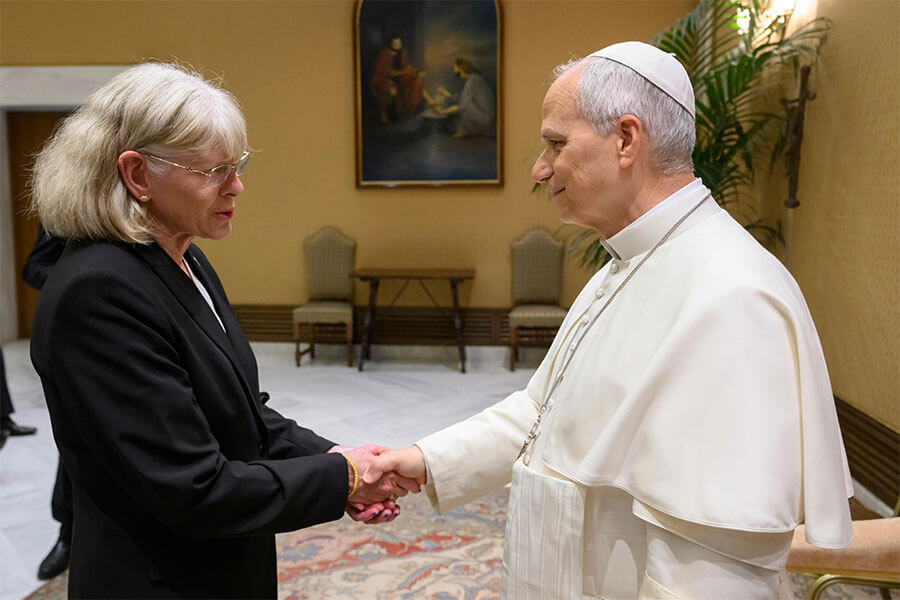
On June 3, Erevelles, along with 20 other Catholic university presidents who were also a part of the Association of Catholic Colleges and Universities’ Rome Seminar, met with Leo in both a group and individually. It was this meeting that served as the catalyst for the University’s pledge of 10,000 hours of service.
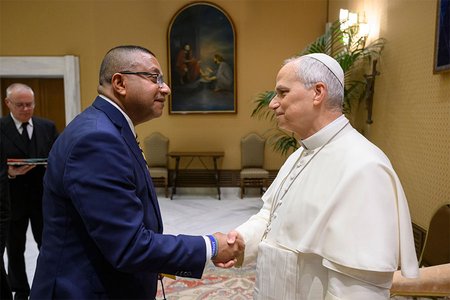
It was an awe-inspiring moment. Other than his wedding day and the birth of his children, Erevelles said this was his most memorable experience.
“A papal audience is high on the list of things that can happen to a human being,” he said.
While it may be the first meeting between the leader of the Catholic Church and the University president, St. Mary’s faculty, staff and members of the Marianist community have a long history of meetings with various popes throughout history. Some of those interactions can be seen on pages 14 and 15.
St. Mary’s is one of 178 Catholic institutions of higher education with the association. Members of leadership travel to Rome biennially, working with the Lay Centre at Foyer Unitas, an educational institution open to members of the lay community.
The six-day trip was packed with visits and seminars. This included masses at the Chapel of Santa Monica degli Agostiniani and St. Peter’s Basilica, the burial site of St. Peter.
Meetings were held with officials from various Vatican departments, such as the Dicastery for Culture and Education (focused on Catholic identity in education and in cultural dialogue) and the Dicastery for Institutes of Consecrated Life and Societies of Apostolic Life (guiding the Catholic Church’s work globally).
When the big day came, Erevelles and the others sat in the Audience Hall adjacent to the general audience room. It was dark and rainy at the Vatican. Leo came prepared, quipping that the “light shines from inside” that day.
Speaking for about 30 minutes, the pope’s message was clear: It is the duty of Catholic institutions to educate students beyond their degrees.
“Yours is the noble task of guiding that desire for knowledge so that they may also learn to seek and love the truth, to reflect on the meaning of life and to recognize the dignity of every person,” Leo said.
After the group address, attendees were allowed to meet individually with the pope. Debating what to say with his wife, Christine Erevelles, M.D., who was also on the trip, Winston Erevelles decided to give Leo the verbal love, prayers and greetings from the faculty, staff and students at the University.
He also gave the pope a Marianist prayer book and a University-branded pen and notebook. But the physical gifts were not enough. The leaders of the universities began discussing other ways to honor Leo.
“What do you give a man who doesn’t need or want anything?” Erevelles said. “And then we asked, ‘Why don’t we pledge him service?’”
At first, the group thought 100 hours of service from each of the 21 universities would suffice. That number was determined to be too small. Eventually, they settled on 5,000 hours.
When Erevelles returned, he fired off an email that included Director of Community Engagement Pete Oviedo, whose office oversees Continuing the Heritage.
The response he got was almost immediate.
“Pete said, ‘We can easily do 10,000,’” Erevelles said.
To 10,000 and beyond
Oviedo doesn’t believe 10,000 hours of service is a braggadocious goal.
The official kickoff for obtaining service hours was Continuing the Heritage. Still, but students had already volunteered toward the goal during Summer of Service, where they lead a five-week summer camp at Holy Rosary Catholic Church, next door to campus.
St. Mary’s volunteers logged more than 2,100 hours during the summer. Students volunteered another 2,232 hours during Continuing the Heritage, pushing the University almost halfway to its goal.
At a $17-per-hour estimate of how much student volunteering saves local organizations, the service equated to a contribution worth $38,000 between June and August.
“This is the part where we get to put our values as a Catholic, Marianist university into action,” Oviedo said.
Reaching a set number of hours was never a concern. Keeping students involved throughout the academic year is the larger goal.
Some campus organizations make service a requirement.
Amy Arismendez, Program Director for the Marianist Leadership Program, said members of the faith-based scholarship program must complete 15 hours of service each semester. Many will donate time to Holy Rosary Parish, Catholic Charities or Saint Mary Magdalen School, for example.
But Arismendez also encourages students to volunteer at sites outside their comfort zone. For example, if they are shy, she urges them to try roles that may require them to be more outgoing.
Her goal is to ensure that community service affects people.
“When you’re challenged in your faith, when you’re in a new situation, things happen where the Lord’s going to intervene and take care of you and your community,” she said.
Human dignity for all
All types of service make an impact on human dignity — the belief every person has equal worth, and that no one’s value is based on their wealth, status, race or gender.
The pope’s focus on human dignity also includes the use of AI. He does not call the technology antagonistic to humanity or inherently evil, but wrote it is never neutral because it takes on characteristics of its creators and users.
Thompson said the use of social media and other online platforms can make people forget electronic communication still has a real person on the opposite end.
“Because we live in a world of social media, technology and relationships by fingers, it’s easy to believe what is happening is just on a technological level,” Thompson said.
James Greenaway, Ph.D., knows all too well how human dignity can be forgotten.
The San José-Lonergan Chair in Catholic Philosophy lived in Northern Ireland during the Troubles — a three-decade, nationalistic fight over the region’s connection to the United Kingdom that was rife with violence.
James Greenaway, Ph.D.“If we don’t meet people face-to-face, if we don’t talk to them and listen to them and share the insights into our experiences, and listen to the insights from their experiences, we never become more than we were before. That’s what human beings do: grow their own personal world of meaning and develop attitudes that are conducive to the development of the common good.”
The official end of the conflict came in 1998, but agreements, Greenaway said, don’t make issues go away. It takes time, meetings, understanding and the ability to see past tribalism and view each other as humans.
“If we don’t meet people face-to-face, if we don’t talk to them and listen to them and share the insights into our experiences, and listen to the insights from their experiences, we never become more than we were before,” he said. “That’s what human beings do: grow their own personal world of meaning and develop attitudes that are conducive to the development of the common good.”
Religious views of human dignity don’t differ from the philosophical ones.
Dignity is universal and unconditional, said Sister Nicole Trahan, F.M.I., who, until recently, was the University’s Director of Marianist Initiatives and Special Projects. There is no such thing as a person undeserving of dignity.
After leading a faculty and staff retreat for those who want to grow in their faith, along with a Living and Learning Community in Dougherty Hall for first-year students, Trahan said sometimes it can be easy to forget what connects people.
“We have inherent dignity given to us by God, our Creator,” she said. “That means we should respect each human being and respect the gift that each human being is. AI can’t replace that.”
Continued fulfillment
Something happening once is happenstance. Twice is coincidence. Three times is a pattern.
Jason King, Ph.D., is seeing a pattern.
Referring to the third annual Higher Education Holistic Report, King, the Beirne Director of the Center for Catholic Studies, said results from his inaugural study in 2024 remain consistent.
Polling alumni from Catholic-affiliated and secular universities, the numbers continue to show a stronger sense of purpose and direction from Catholic school alumni.
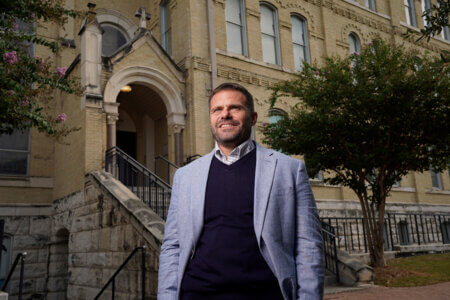
Over a three-year average, 7% say their life is close to ideal and 19% are more likely to say morality is part of their decision-making.
In the latest report, for year three of the study, 21% of religious-affiliated alumni say they have a stronger sense of belonging and 7% more likely to have volunteered in the previous six months.
Some of the ways alumni gave their time were volunteering at animal shelters, serving as an elected official or coaching a youth sports team.
“We’re in this situation where we need to remember that all we do is about serving humans with dignity,” said King, reflecting on the pope’s encyclical. “It’s important because the document kind of applies it to AI, but Leo really is trying to make sure that we see that God loves us, and that human beings have dignity because they’re made in His image.”
What happens, though, when there are fewer Marianists left to continue sharing their message?
Since its founding nearly 175 years ago, St. Mary’s has worn its Marianist heritage on its proverbial sleeve. While serving in campus roles, professed members of the Society of Mary and Daughters of Mary Immaculate, also known as the Filles de Marie Immaculée, have sparked students’ affection and spiritual interest for generations.
However, their numbers are decreasing. The Marianist website estimates there are only 200 professed members in the United States. The talk of the lay community — a group of nonordained people who have gone through formation and commitment — picking up the yolk has not been uncommon.
One St. Mary’s professor is trying to get ready for when that day comes.
For the last three years, Camille Langston, Ph.D., Professor of Communication Studies, has connected with Brother Dennis Bautista, S.M., Ph.D., in Rome to develop a curriculum for Honors Program students called the Honors Global Leadership Program.
Since its founding in 1852, those associated with St. Mary’s University — Professed Marianists, faculty, staff and students — have had a chance to meet with a pope or be in attendance for a general audience. In these photos you’ll see members of the University community who have had a chance to meet with different popes throughout the decades.
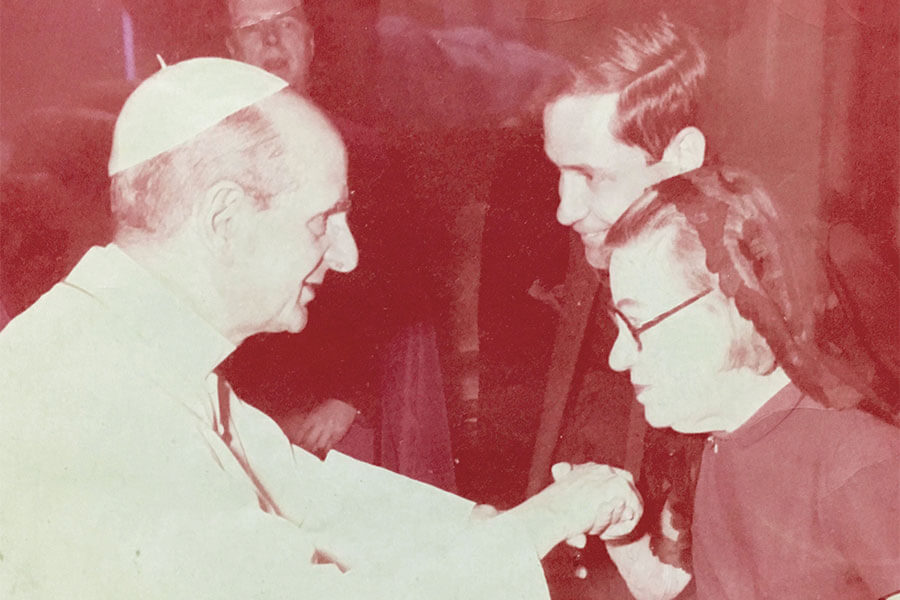
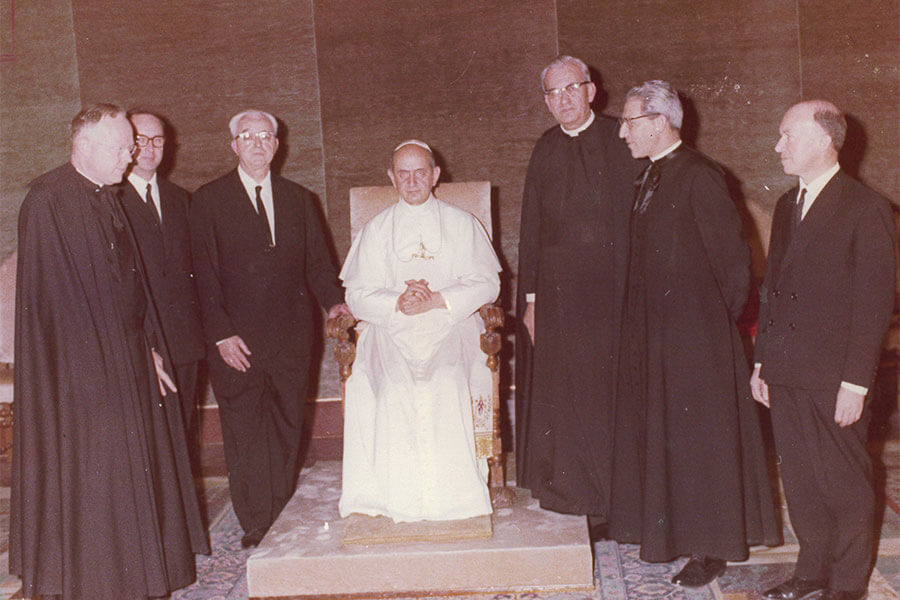
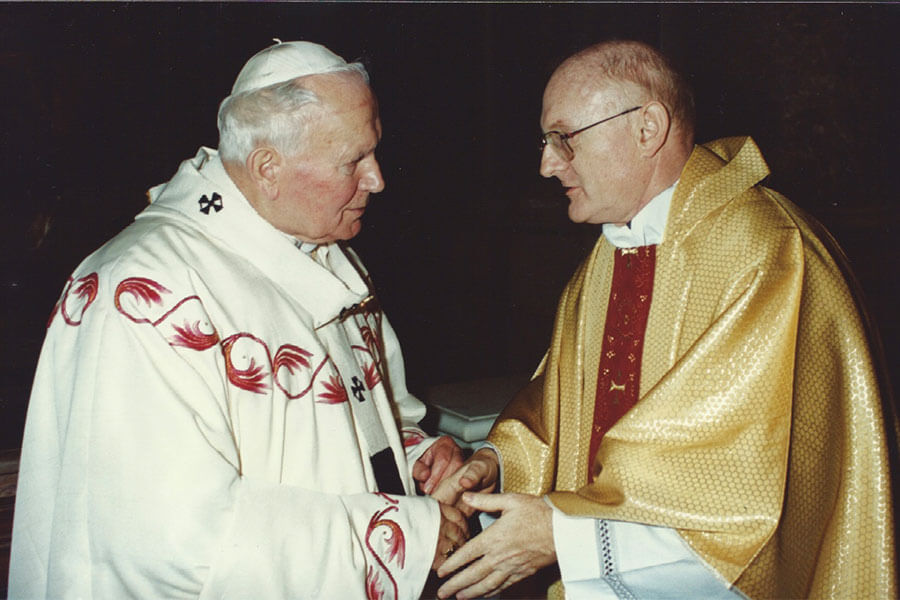
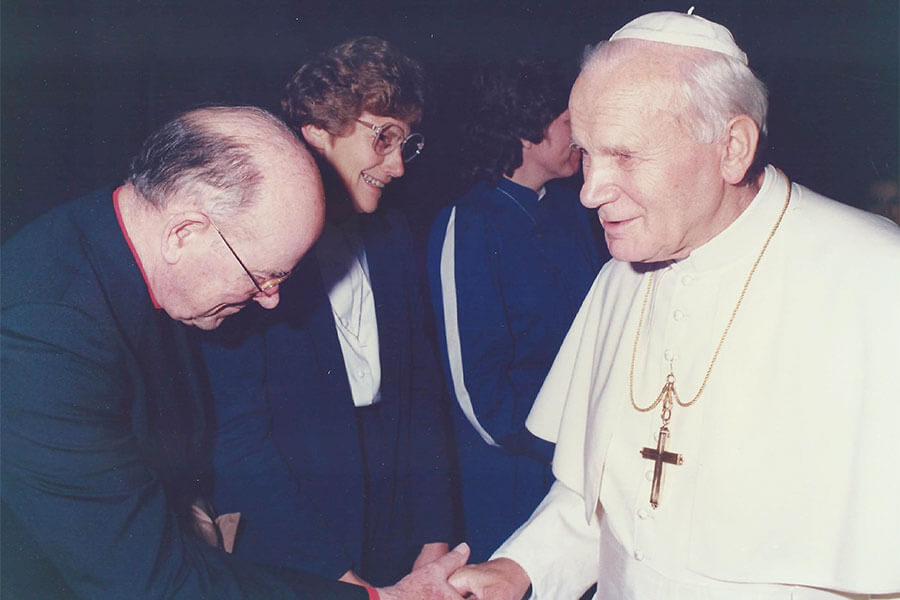
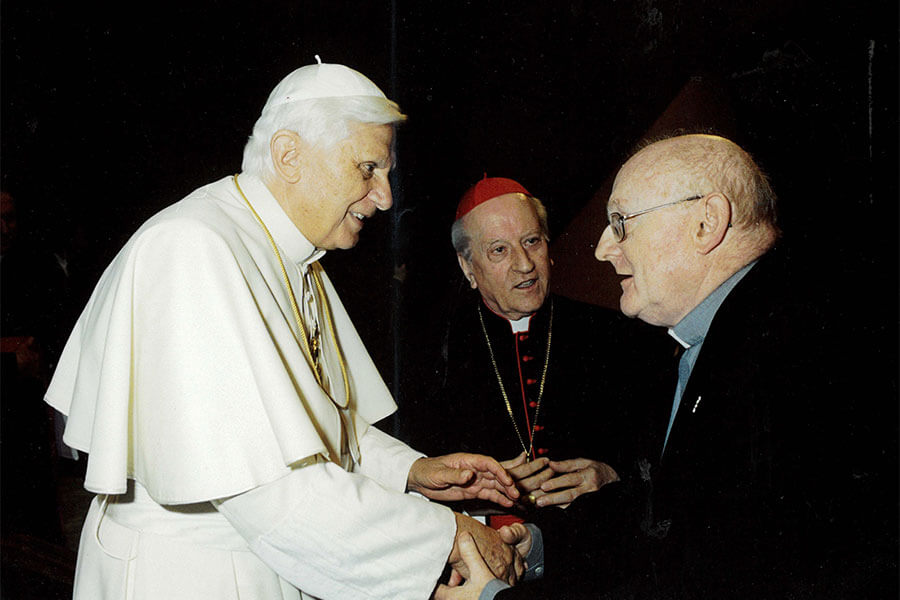
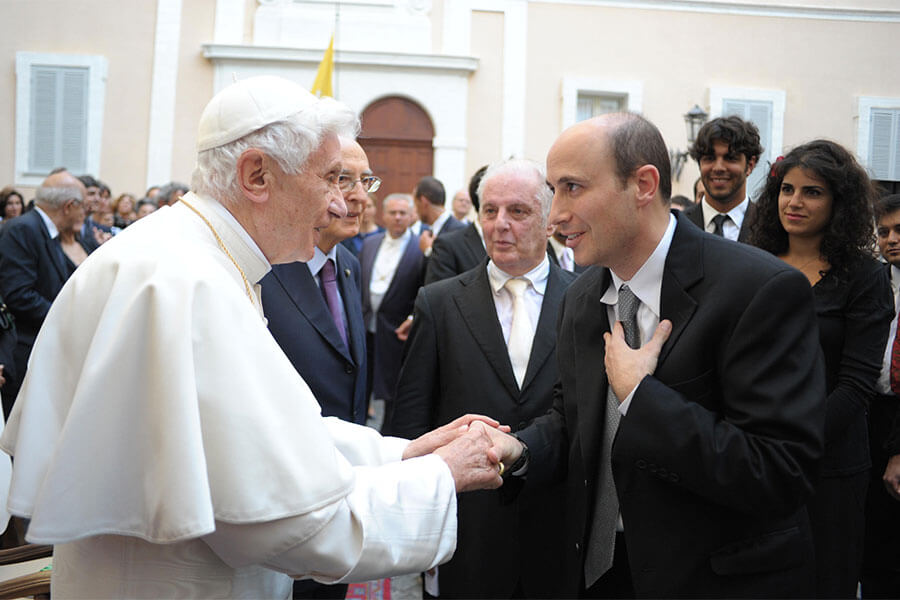
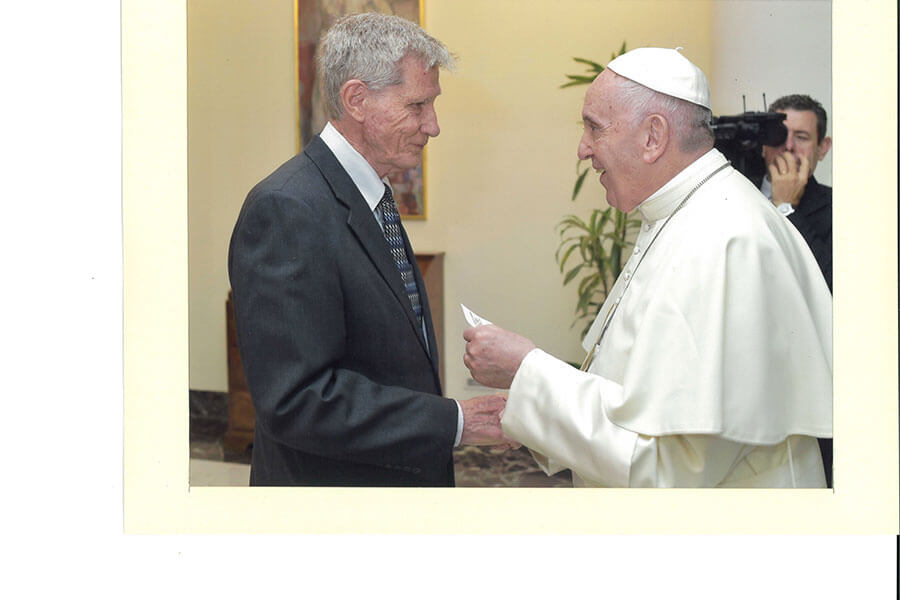
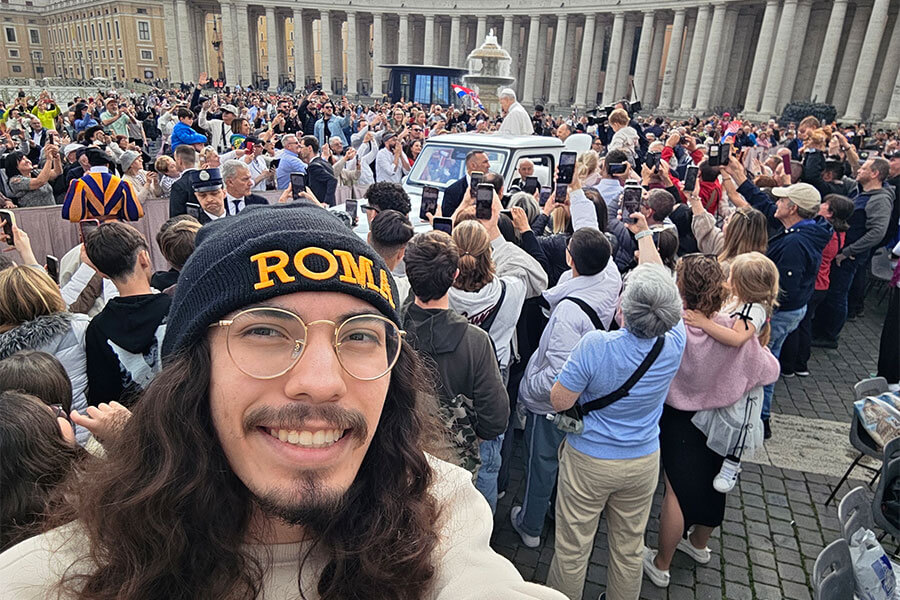
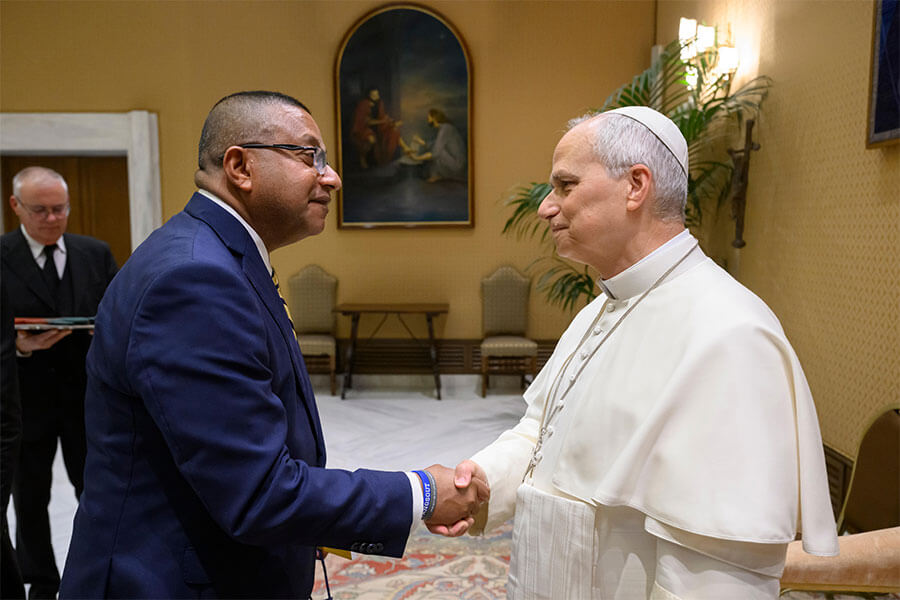
During Spring Break for the last three years, the Honors Program took students to stay with Marianists at their residence, Via Latina, in Rome. While the trips each lasted a week, the research, discussions and commitment are year-long
In this program, the students examine how Catholic education shapes their skills and challenges them with real-world problems. Are there solutions to expand the number of professed Marianists? How can the University continue to integrate Marianist characteristics into the curriculum?
Students also get the opportunity to attend a general Papal Audience.
“The program does more than just send students to see Rome,” Langston said. “It’s about sending them to encounter a way of life. We want our students to return with a deeper faith, a stronger understanding of themselves as leaders, and a renewed sense of what it means to carry the Marianist mission forward.”
Someone who can serve
On the baseball diamond at Holy Rosary Parish during the blistering July heat, Valeria Garcia stood as a field umpire in the middle of an intense kickball game.
Working as a summer camp counselor during Summer of Service, the senior Communication Studies major had looked for service opportunities when she learned about the position.
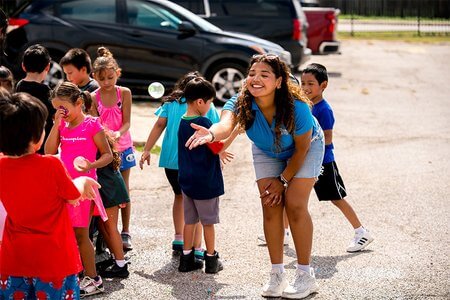
Giving back is important to Garcia’s family. One Christmas, her family made food for distribution in her hometown of Corpus Christi instead of having a traditional holiday meal.
“We drove around downtown Corpus giving out tamales and hot chocolate,” she said. “It was a meal for people who didn’t get to go home or didn’t have a home to go to.”
The change to work with children was more than just volunteering; it hit close to home for her. Garcia’s parents were continuously working when they could find employment. Going hungry and having to skip buying new clothing growing up was normal.
Many of the children who attended the summer camp at Holy Rosary came from low-income households. Having something constant in their lives, Garcia said, makes a difference.
“I’m familiar with what it feels like to be in their place,” she said. “That’s why my family gives back because we believe that it’s God’s will.”
During Continuing the Heritage, Joshua Lopez found himself more committed to his decision to become a Nursing major — a profession known for compassion.
Lopez was one of 18 students who found themselves on Laura Melody, a street on San Antonio’s East Side that Saturday. The sounds of construction could be heard across the new subdivision.
In the morning, members of Habitat for Humanity of San Antonio welcomed and directed the volunteers who showed up to help the nonprofit build affordable homes for families in need.
Under a tent, the St. Mary’s students received a quick safety briefing from their on-site leader, Charles Mendoza of Habitat for Humanity. Everyone was adorned with aprons, gloves, hammers and safety glasses.
Before beginning their work, Mendoza asked if it was okay to say a quick prayer.
“Of course it is,” he said, removing his hat. “Y’all are from a Catholic school.”
Despite their light-heartedness, the students took the task at hand seriously. They listened while Mendoza spoke about the importance of a house’s design. Slowly, they began breaking off into groups. Each measurement of lap siding was taken twice. Cuts were made once.
Many of the volunteers working in the newly named Pope Leo Village knew each other as fellow members of the Knights of Columbus, a Catholic fraternal organization with a student chapter. Others were meeting for the first time and bonded over community service.
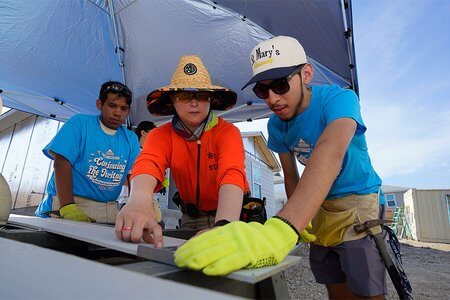
Lopez knew immediately he wanted to join the Marianist Leadership Program because of its dedication to service and faith.
Going to school, he said, it’s easy to get wrapped up in completing course assignments and maintaining a good grade point average. Putting oneself out there to do things for others is a reminder of how things can be bigger than oneself.
“When you’re doing service, it reminds you that not everything is for a grade,” Lopez said. “Serving is a great thing because you’re not just helping others, you’re getting the satisfaction of knowing you’re contributing to your community.”
Human dignity and service to others are staples of the Marianist mission. Its focus on social justice — that all individuals regardless of background deserve fair and equal treatment — is interwoven into all facets of the University. Benefiting the common good helps everyone prosper.
Contributing 10,000 service hours for the pope will be a monumental moment in the University’s history. It will benchmark service goals going into the future.
“As a Catholic institution, the common good is the starting point, and we have to go beyond the common good because of our faith,” the Rev. John Thompson, S.M., said. “We believe in something bigger than the common good; we believe in the Kingdom of God. Where the common good could be the endpoint for many other institutions, that’s our starting point.”