
The new creators
by Nathaniel Miller
The single stroke of a paintbrush can be the start of a grand masterpiece. The striking of an opening piano chord could send the world on a musical journey.
A single class can be the catalyst for inspiration.
St. Mary’s University, grounded in its Catholic and Marianist mission, puts a profound focus on its Core Curriculum, a set of courses required of all students.
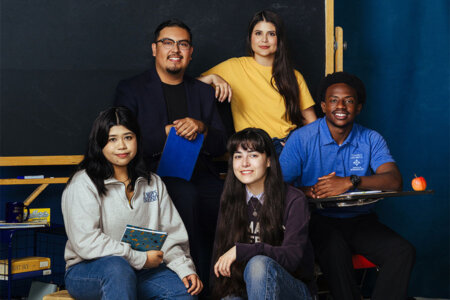
These courses, outside a student’s primary field of study, lay the foundation to see how their major fits into the wider world, providing the framework for a career while showing how work can benefit the community.
“Educating the whole person through the liberal arts remains a core commitment in Catholic higher education,” said Jason Pierce, Ph.D., Provost and Executive Vice President. “We know from our graduates and our own research, including the work of Jason King in the Center for Catholic Studies, that this broad-based education at St. Mary’s prepares students for a complex and diverse world, and equips them for an evolving workplace, including careers that don’t yet exist.”
According to the Center’s study, Catholic university graduates report a 10% increase in their sense of direction, a 15% greater likelihood to be fulfilled in their social lives, and a 13% greater involvement in their communities.
Part of that education at St. Mary’s comes from liberal arts courses, giving students leeway to apply classroom lessons in real-time. Through their courses, they produce original works of art and research and embark on entrepreneurship.
Many times, inspiration for projects comes unexpectedly.
With more than 30 years of teaching experience, Professor Emeritus of Art Brian St. John, M.F.A., who retired in May, has seen students come through expecting to check off their fine arts class only to find themselves immersed in their projects.
“St. Mary’s University is a liberal arts institution, and we offer a curriculum that is designed to liberate and enrich the lives of our students through a broad education across the spectrum from the sciences through the humanities,” St. John said. “The inclusion of a fine arts requirement in the core curriculum further extends the reach of that spectrum through the investigation of the creative process and design.”
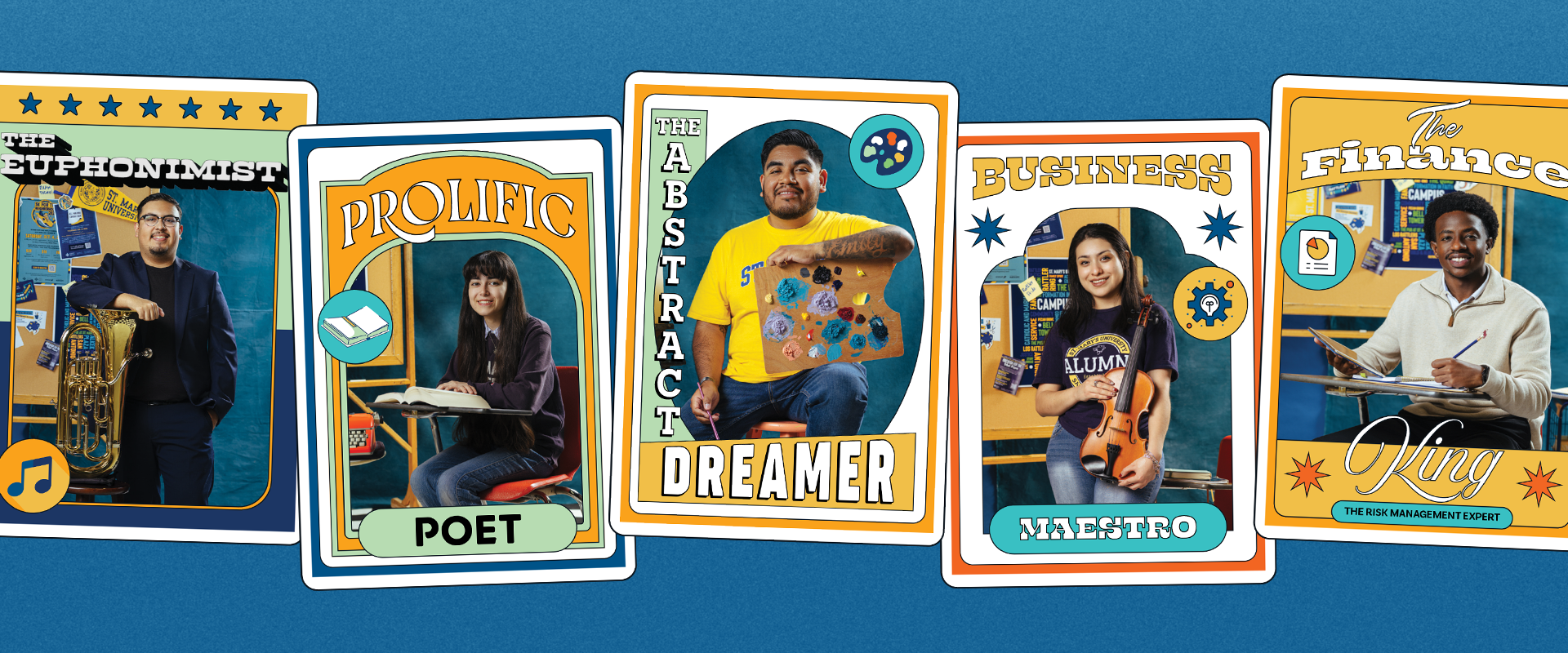
The Abstract Dreamer: Expressing critical thinking through art
Juan Daniel Rodriguez Rios (B.A. ’26), Criminal Justice major with Art minor
Juan Daniel Rodriguez Rios never dreamed he could make a living out of art.
Growing up in Ontario, California, and moving to Baton Rouge, Louisiana, at 15, he served as a corporal in the U.S. Marine Corps and a sergeant in the U.S. Army before settling in San Antonio after meeting his wife.
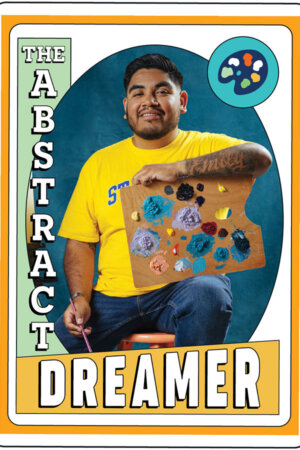
“I’ve always enjoyed doing art,” he said. “I even worked as a tattoo artist after I got out of the military.”
With aspirations of becoming a police officer, Rodriguez Rios began pursuing a degree in Criminal Justice, until he took Digital Art with Associate Professor of Art James Joffe, M.F.A. It inspired him to take more art courses.
Soon, Rodriguez Rios added an Art minor to his degree.
His passion has led him to create pieces featured at the San Antonio Art League and Museum — one of a blind Lady Justice with a gold banner across her eyes. Another piece shows a child walking down a desolate, war-torn highway chasing a shining dove.
Joffe said art is crucial to not just expression, but critical thinking.
“I am a strong proponent of a liberal arts education, especially as the world is changing and adapting to machine learning and AI integration,” Joffe said. “I have heard many wise prognosticators say that creative types, with strong imagination and writing skills, will be of great benefit in the future.”
The education he received at St. Mary’s has encouraged Rodriguez Rios to continue his art education. He has been accepted into a Bachelor of Fine Arts program at another university. His dream is to return to St. Mary’s as a professor to inspire a new wave of artists.
“I have nothing but extreme gratitude toward the school and toward my professors,” he said. “I’m going to go do something that I am passionate about, and I wouldn’t have thought about doing it if it wasn’t for them.”
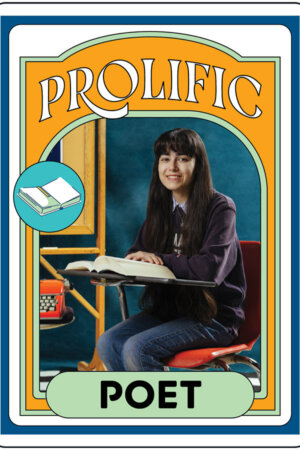
Prolific Poet: Communicating effectively through storytelling
Mary Arnolds (B.A. ’25, M.A. ’26), Combined bachelor of Arts in English and master of Arts in English Literature and Language
If there’s a story to tell, Mary Arnolds wants to hear it.
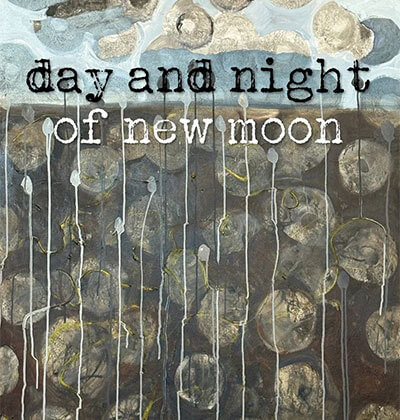
Being involved with the Pecan Grove Review since her sophomore year, the Corpus Christi native was associate editor-in-chief of the publication’s editorial board, taking the utmost care with submissions. She even designed the latest cover image.
Established in 1995, the Pecan Grove Review is the University’s literary magazine, printed each spring and featuring writing from St. Mary’s students, faculty, staff and alumni.
Combined bachelor of Arts in English and master of Arts in English Literature and Language
The magazine gives students an opportunity to experience and obtain a realistic publishing experience. It receives myriad submissions, including poetry, analysis, fiction and everything in between.
“Sometimes you have to deliver criticism, but you never want it to be in a way that is going to discourage people from submitting their creative work,” Arnolds said.
Having an interest in language, Arnolds enjoys editing and giving feedback. The liberal arts education she’s received, she said, allows her to use different writing formats and understand how people in various fields approach their work.
Her fondness for words also led her to her own published poems, such as Encounter with a Stagnant Pool and I Dream of Fawns and Fledglings — pieces using nature to reflect on self and the pains of adulthood transition.
The Spring 2026 edition includes her creative nonfiction piece, Oso Creek, a tribute to the lively wetlands in Nueces County.
Editing goes beyond fixing punctuation marks and crafting flowery prose. Working at a law office and taking courses outside her major have shown her the benefits of effective communication.
“You’re going to work with people who have different ways of communicating,” Arnolds said. “If I had just been siloed into English, it wouldn’t have been helpful. If all I know is MLA formatting for literary criticism and I’m working with technical or scientific writers, I’m not going to be prepared for that.”
Arnolds wants to pursue editing full time in both literary and research writing. Wherever she lands, she knows she’s ready to help make anyone’s writing the best it can be.
“These lessons and skills have taught me how to help others communicate to the best of their abilities,” she said. “Classes I’ve had and people I’ve met made me more comfortable with these skills.”
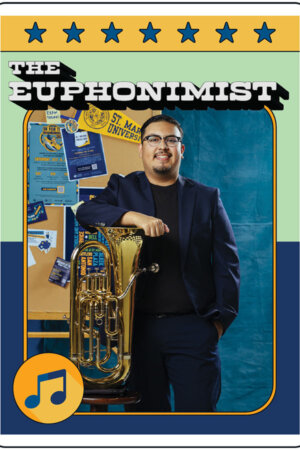
The Euphonimist: Marching to the beat of his own music
Alejandro Calderon, junior, Music major with teaching certification
Growing up in San Antonio, Alejandro Calderon described himself as a “band kid in band,” someone playing an instrument in the ensemble, but not taking it as seriously as he could.
His band director at Clark High School, however, saw more. Being able to play well didn’t mean “the job was done.” His director pushed Calderon to challenge himself.
Music major with teaching certification
“I originally thought I’d get my degree, perform a bit and bounce,” he said. “But my professors have been helping me, and getting feedback from people about my music is a rewarding feeling.”
His dedication to composition, music theory and playing the euphonium led to an opportunity for him to compose a piece representing the University at the 2024 Texas Music Education Association.
His arrangement, Dying Light, sounds dark and deep, foreboding tubas resound until a euphonium cuts through with sharp precision. Listeners find the musical equivalent to wandering in the dark as they are guided into the light.
Those sounds come from Calderon’s experiences growing up as a first-generation college student.
“It feels like being stranded, and you don’t know what path to take,” he said. “You go through all these different emotions and different stages of danger, but then in the end you eventually find your own way.”
Not all his compositions are serious in tone. He’s written original pieces with the St. Mary’s Jazz Band and for the annual Fiesta Jazz Festival. His work has even received attention from another Texas university that has commissioned his music.
With opportunities he never thought possible, Calderon has not lost sight of his ultimate goal: taking his love of music to inspire others.
One of his classes, called Teaching Diverse Populations, has shown him how beneficial music is in a classroom setting and how it can be an effective tool for communication. He would know. Music has given him the chance to communicate through his work.
“The community at St. Mary’s wants you to feel like you belong and you have a voice,” Calderon said.
Researcher Extraordinaire: Making science accessible to others
Chiara Maldonado (B.S. ’26), Forensic Science – Biology Track major
When the chance came to work in a lab researching microplastics, Chiara Maldonado didn’t think twice about applying.
Little did the San Antonio native know that her time and effort would be rewarded with being the first author of a peer-reviewed article about how tiny plastic debris, reported by scientists to already be found in the human body and blood, affects lifespan and fertility.
In academic research, the people who perform the majority of the research are listed as the first authors on articles.
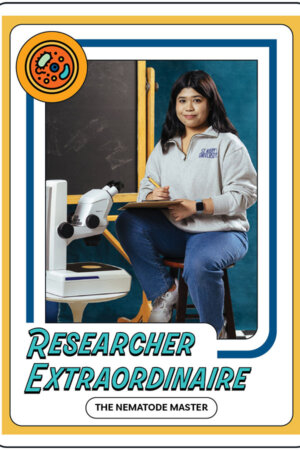
For the research, Maldando used nematodes — microscopic worms also known as C. elegans — as model organisms for human development, health and disease because of their high genetic similarity with humans.
“I thought I was going to be a forensic medical examiner,” Maldonado said. “Once I started the research fellowship at St. Mary’s, it opened this new world to me.”
Explaining the work, however, can be a challenge. Maldonado’s time at St. Mary’s has taught her the importance of effective communication, especially when showing how science interacts with other areas of study.
“You need to treat science with an ethical point of view as well,” she said. “As much as there is to science, we’re all still human, and people have different ways of thinking.”
Ways she has shared her scientific discoveries include
making comics and educational videos, and sharing her knowledge with school-age children through community outreach events.
According to the U.S. Department of Labor, only 26% of jobs in all STEM fields are held by women. By making science more accessible, Maldonado hopes to encourage more people to consider a career in science.
“I enjoy what I’m doing, and St. Mary’s was able to guide me because the University introduced me to research opportunities,” she said.
Engineering Wizard: Embracing change with a Texas favorite
Gabriel Tello (B.S. ’26), Industrial Engineering major
When it came time for his senior design project, Gabriel Tello knew working alongside a Texas-favorite restaurant would be more than just another assignment.
But he was up for the Whatasized task.
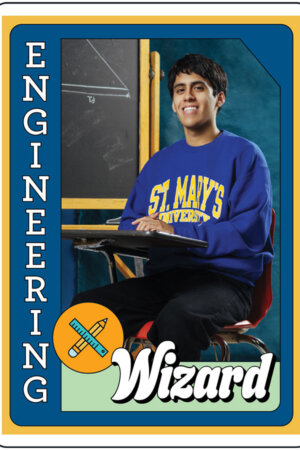
Living in both Miami and Peru before coming to St. Mary’s, Tello’s project with Whataburger, the San Antonio-headquartered fast-food restaurant, was to design a new kitchen for the company. The goal is to conceptualize a floor plan that decreases serving times and reduces overall food waste.
“They’ve implemented this new kitchen near St. Mary’s University,” Tello said. “The design may be implemented in other restaurants depending on the success of this one.”
The concept does more than just find ways to serve mouth-watering hamburgers and hot french fries quicker during peak hours. Reducing waste aligns with the St. Mary’s mission as a Laudato Si’ university, falling under the goal of ecological economics, which calls for sustainable production and consumption.
Alongside Whataburger’s own engineers, Tello is working with a student at ICESI University in Colombia, who studied at St. Mary’s before returning home.
Tello said the education he received at St. Mary’s is different than the one he received in South America. Through his theology and philosophy classes, his perception of what a successful product looks like includes more than just a working product.
“St. Mary’s has taught me critical thinking,” Tello said. “If you study in a technical school, you don’t always consider the human factor, social factors or the environment. That’s something I was never taught in Peru, and it really caught my attention.”
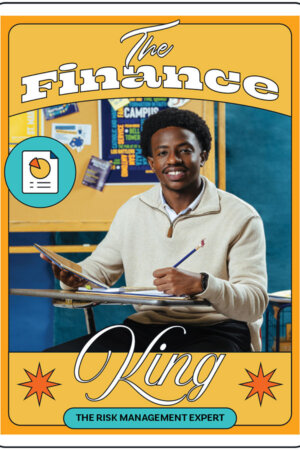
The Finance King: Helping you maintain control of your finances
Max Masabo, junior, Finance and Risk Management major
Max Masabo, like most high school graduates, sought independence as he began his college career.
Leaving his home in Kigali, Rwanda, for the United States marked his first excursion outside his home country.
Luckily, his two older siblings — Linda Masabo (B.S. ’25, M.S. ’26) and Marvin Masabo — were already at St. Mary’s University, making his decision where to go easier. But that did not mean he wanted to follow in their exact footsteps.
Finance and Risk Management major
“I find joy in learning business and economics,” he said. “I took this route because I see how I can benefit, not just myself, but others around me.”
In February, Masabo attended the Academy of Economics and Finance annual conference to present a paper he researched and published on the effects of phone apps marketed to help people with their personal finances.
His research included user characteristics such as age, educational background, how they found the apps and their overall understanding of financial literacy. In short, his research found that it takes more than an app to help some get their money in order.
During the three-day conference, he met Stanford University Professor of Finance Annamaria Lusardi, Ph.D., who is the author of one of the works cited in
his research.
“Having the chance to talk with her and hear her feedback on what she thinks about my paper really got me thinking about how many things I can improve and look into with different research opportunities,” Masabo said.
With a strong religious upbringing, Masabo said he’s found through his study of finance that numbers do not care about a person’s religion or beliefs. The liberal arts education at St. Mary’s, along with his work as a resident assistant and also a President’s Ambassador, who are student leaders representing the Office of the President, has helped him see how others’ experiences help shape their decision-making.
The lessons he’s learned in his myriad roles at the University and his research have strengthened his commitment to helping those around him.
“St. Mary’s has opened my eyes to see that, at the end of the day, we are all trying to live our best lives,” he said.
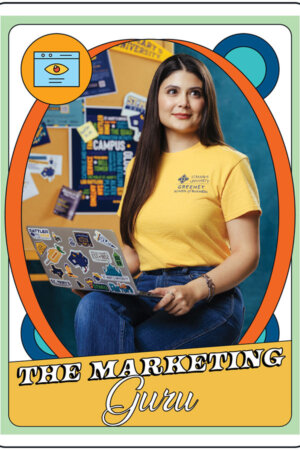
The Marketing Guru: Exploring AI in consumerism
Belyn Thompson (B.B.A. ’26), Marketing major
Belyn Thompson can talk about artificial intelligence for hours.
The San Antonio native first began discussing the technology with Associate Professor of Marketing Zecong Ma, Ph.D., during her sophomore year. Her interest in how AI affects consumers became her main focal point.
That interest, with Ma’s support, led Thompson to become the first author of an article about how AI-generated images affected purchase intention compared to human-made images.
Marketing
The use of AI has the potential to offer faster work output and cost savings. But consumers give mixed responses when looking at AI-generated images of people.
“There’s going to be some uncomfortableness with AI replacing actual humans because it’s not making cartoons; what it’s making is realistic,” Thompson said.
Presenting her findings at the 2026 American Marketing Association International Collegiate Conference in Chicago, Thompson won first place for her research.
Her work runs in tandem with the University’s continued exploration of AI as a tool in keeping with its mission.
“I was happy to be able to represent St. Mary’s and get an award, but I’m proud to help get St. Mary’s the recognition that it deserves,” she said.
With the goal of obtaining a Ph.D., Thompson said St. Mary’s is preparing her for more than just her major. She has learned professional skills as a President’s Ambassador.
The classes in the core curriculum have also taught her to look beyond herself. As AI expands across people’s lives, Thompson’s work helps demonstrate how technology affects people at numerous levels.
“Being in a Catholic school taught me so much about the Marianist mission, the mission of St. Mary’s, and made me feel like a better person overall,” she said. “I’ve grown to be more empathetic, more caring, more understanding and better able to see that people need different things and find ways to help uplift them.”
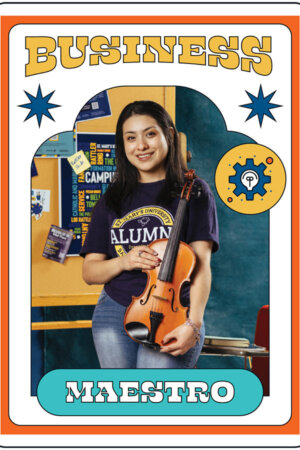
Business Maestro: Sharing the sweet sound of business
Victoria Olguin (B.B.A. ’25), MBA student
If starting a business and playing the violin were difficult tasks, no one told Victoria Olguin.
A musician since middle school, the Cedar Creek native wanted to attend a university where she could keep playing while immersing herself in as many activities as possible.
As an undergraduate, Olguin took part in the St. Mary’s Orchestra and Mariachi group, while also serving as editor of The Rattler student newspaper and as a President’s Ambassador.
After earning her bachelor’s degree, she continued to play violin at church, receiving recognition. She was one of only two violinists and her passion for music drew attention.
MBA student
Soon, parishioners began asking her to teach them the instrument, giving them a chance to tap into their own artistic side. It was music to her ears.
“I started offering classes, and it started to grow from there,” she said. “I started in Rockne and then expanded to Smithville. Now I’m trying to expand to Bastrop and Austin.”
Still working on her business website, Olguin is accepting more students and expanding the clientele.
But even she knows that music is not the only medicine that heals the soul.
Currently working at Lake Hill Pharmacy in Austin, Olguin is pursuing her Master of Business Administration degree at St. Mary’s while also becoming a certified pharmacy technician on her way to better understand the medical industry — an area she did not imagine she would work in.
“A liberal arts education prepared me to be flexible and to be able to work with others who studied something different from me,” she said. “It’s prepared me for these job opportunities.”
Her music has been an expression of herself and her faith. Music is one of many ways Olguin honors God and gives back to her church community.
Without St. Mary’s, she said she does not believe she would have been able to merge her education and love of music.
“If you are constantly working or studying and don’t take time to explore yourself in different ways artistically, then you limit yourself,” she said.