

SIM-ply amazing hands-on experience
by Nathaniel Miller
It takes a lot of hard work to become a nurse.
At St. Mary’s University, the Bachelor of Science in Nursing prepares students to become practice-ready professionals by integrating a liberal arts education and Catholic and Marianist values.
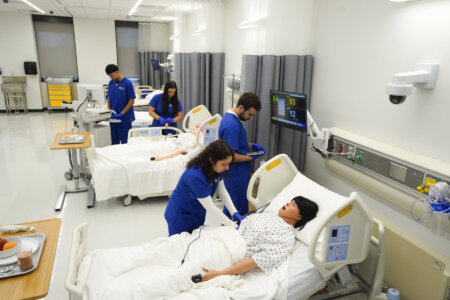
Alongside classroom theory, students are exposed to hands-on experience from clinical sites and the Simulation and Skills Laboratory inside the Blank Sheppard Innovation Center.
To better understand the importance of simulation labs, Clinical Assistant Professor of Nursing Eloisa Garza talks with Gold & Blue about how the labs play a vital role in a student’s education.
Q: What is a simulation lab?

A: A simulation lab is a safe, realistic learning environment where nursing students can practice patient care skills, clinical decision-making, communication and teamwork before caring for actual patients.
It recreates healthcare settings such as hospital rooms, clinics, home environments and community settings using advanced technology, high-fidelity simulators, standardized patients, virtual experiences and task trainers.
At St. Mary’s University, our Simulation and Skills Laboratory allows students to learn from experience, build confidence and refine their clinical judgment in an environment where mistakes become valuable learning opportunities.
Q: What are some techniques and scenarios students can expect in a sim lab?
A: Students practice skills such as IV insertion, medication administration, wound care, catheterization and airway management.
Scenarios may include respiratory distress, cardiac events, pediatric care, mental health, home health visits, falls and emergency situations using manikins, virtual reality, AI patients and electronic health records.
Q: How does a sim lab compare to clinicals? What are the differences?
A: Simulation provides a controlled environment where students can practice, make mistakes and receive immediate feedback. Clinicals involve caring for real patients in health care settings, where learning opportunities vary based on patient availability and safety considerations.
Q: What are the benefits of practicing in a simulation lab?
A: There are many benefits of practicing skills in a sim lab:
- Increased Confidence. Students have the opportunity to practice skills repeatedly until they feel prepared to perform them in clinical settings.
- Improved Clinical Judgment. Simulation challenges students to recognize patient changes, prioritize care and make evidence-based decisions.
- Enhanced Communication Skills. Students practice speaking with patients, families, health care providers and interdisciplinary teams.
- Safe Learning Environment. Learners can make mistakes, receive constructive feedback and improve without risking patient harm.
- Exposure to Rare or High-Risk Events. Simulation allows students to experience emergencies and uncommon situations they may not encounter during clinical rotations.
- Preparation for the Next Generation NCLEX. Simulation activities support the development of clinical judgment competencies measured on the licensure examination.
- Development of Professional Behaviors. Students strengthen teamwork, leadership, delegation, time management and accountability skills.
Q: Can simulation hours be substituted for clinical hours?
A: Yes. Research supports the use of simulation as a valuable component of nursing education. Accrediting and regulatory bodies recognize simulation as an effective teaching strategy.
The amount of simulation that may substitute for traditional clinical hours depends on state board regulations, accreditation standards and program policies.
At St. Mary’s University, simulation is intentionally integrated into the curriculum to enhance learning and complement direct patient care experiences. It is used strategically to ensure students achieve course outcomes and develop the competencies needed for safe nursing practice.
Q: What year of the Nursing Program at St. Mary’s University can a student start using the sim lab?
A: At St. Mary’s , students are introduced to simulation and skills experiences during their first year of nursing coursework, where they begin developing foundational nursing skills, communication techniques and clinical judgment.
As students progress through the program, simulation experiences become increasingly complex and include high-fidelity scenarios, virtual reality experiences, electronic health record documentation, home health simulations, pediatric care, mental health simulations and interprofessional activities.
By graduation, students have participated in numerous simulation experiences designed to prepare them to transition confidently into professional nursing practice.