

Precision and purpose
by Jennifer R. Lloyd (M.B.A. ’16)

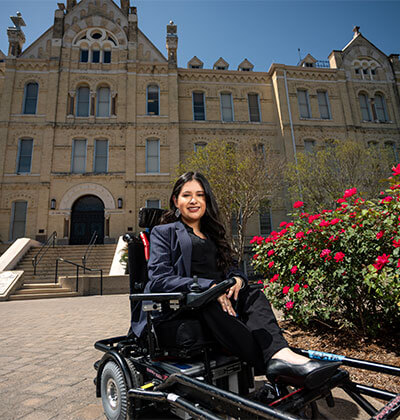
It’s 4 a.m., and Amy Garcés is already awake. The U.S. Navy Reserve veteran is preparing for days filled with caring for twin toddlers, a full-time job as an immunology lab technologist and, starting in August, her course load as one of the first students in St. Mary’s University’s new Master of Science in Medical Genomics program.
The program is the first of its kind for the region, and St. Mary’s is one of only nine institutions internationally to award a master’s in the field of study. The course work will prepare students for the rapidly growing field of medical genomics — the study of the human genome and how it influences health, disease and treatment. This can affect precision medicine, which seeks to tailor disease treatment and prevention to a patient’s specific characteristics, such as their genetics.
Though living in the San Antonio area, Garcés selected the St. Mary’s program, in part, because of the asynchronous format, which will allow her to manage unexpected changes, such as those that could arise from her husband’s service in the U.S. Army Reserve.
Garcés, who grew up in Boerne and went to Schreiner University in Kerrville for her bachelor’s in Cell Biology, shared* her journey to the graduate Medical Genomics Program with Gold & Blue magazine.
Q: What got you interested in medical genomics?
A: My first pique of curiosity was during my undergrad. In 2015, I came across a paper about CRISPR, a tool for modifying genes, and it just blew my mind. Back then, it seemed so sci-fi. Well, fast-forward about 10 years, and there was a case. Baby KJ at the Children’s Hospital in Philadelphia received the first gene editing therapy. So, it’s here. It’s real. It’s happening. Reading that story re-piqued my interest. I really started asking myself, “Is it time for me to step away from clinical research, from infectious disease and into genomics?”
Q: Why did you pick St. Mary’s University to pursue your master’s in Medical Genomics?
A: When I was researching Medical Genomics or Bioinformatics programs, a lot of those available wanted you to do both online and in-person course work. That just wasn’t going to work for me. I needed something fully online and asynchronous because I’m planning to work full time while also pursuing my master’s program.
St. Mary’s checked off all my boxes. It was asynchronous. It was flexible. When I talked to the program director, she said that if I needed to do my classes at 4 a.m., that would be an option. As of right now, that’s my reality. My course work will be done at 4 a.m. I’ve been practicing that schedule with my twins now to see how it works. So far, it’s been a very strict schedule of bedtimes at 8 p.m., and I wake up at 4 a.m. to get it done. So, yeah, St. Mary’s was it for me.
Q: How does being a Navy Reserve veteran and military spouse shape the perspective you will bring into the new program?
A: The military kind of forces you to adapt to different environments, all the obstacles that you face. That includes all the deployments and trying to navigate a career with all those moves. You learn to balance your work life, your military life, as well as your personal life, and make time for family as well. It has given me a lot of perseverance. It taught me resilience and definitely gave me the courage to go after what I want, and to be proactive.
Q: How do you think getting this graduate degree in Medical Genomics will help you make a difference in people’s lives?
A: Once I learn how it works in the clinical realm, how one sample goes from the patient all the way to a treatable product for a patient, I would really like to influence policies on how we’re going to manage this. How is this going to translate for insurance and for the patient? I want to make it equitable. I want everyone to be able to access precision medicine.
When I learned about the St. Mary’s mission, it aligned really well with my personal aspirations of wanting to make precision medicine available for everyone and wanting to have an equitable outcome.
*This interview was edited for length and clarity.