
Ethics in practice
by Nathaniel Miller
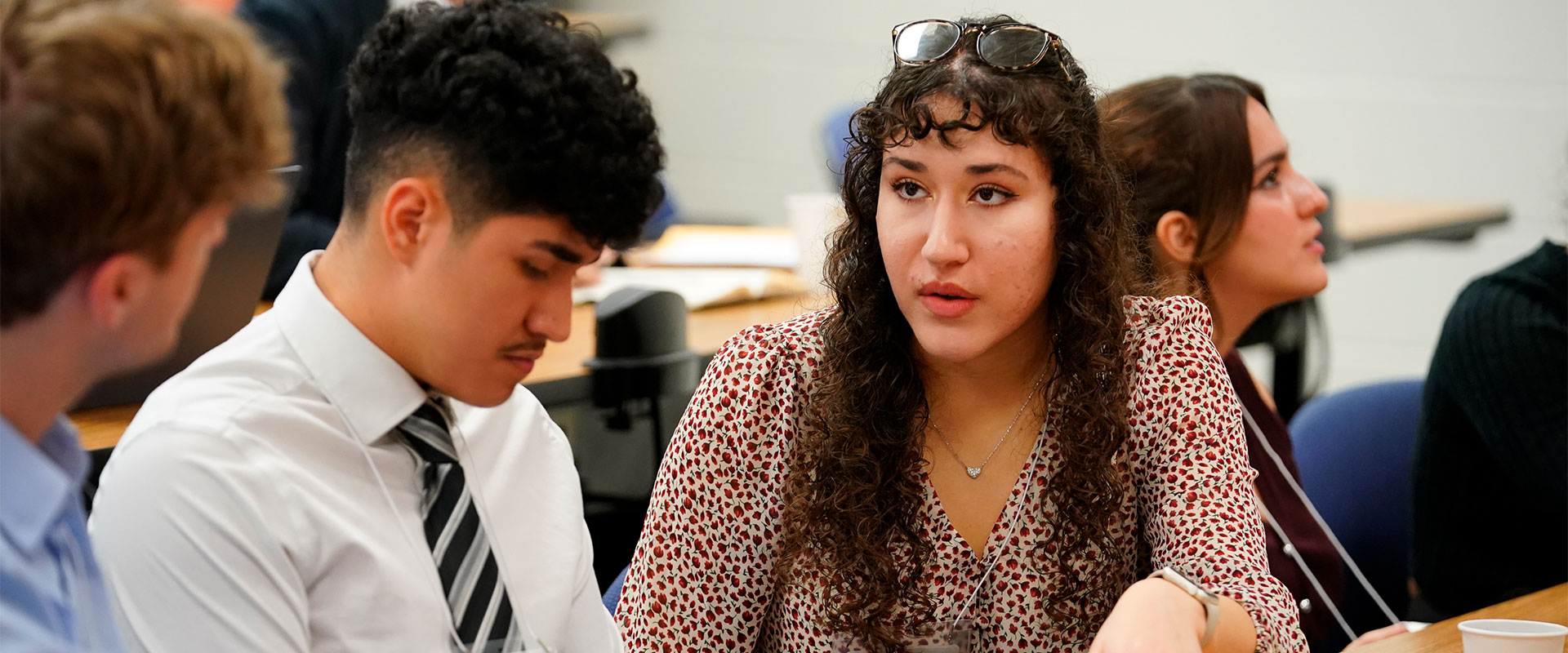
Emily Davey lowers her head, furiously scribbles on her notepad and quickly looks to her left and the right.
Her teammates lean in closer, conferring about what to do next. After a few minutes of hushed whispers, Davey begins speaking.
As a member of St. Mary’s University’s Ethics Bowl team, she starts by asking pointed questions to the opposing UTSA team about their arguments to hypothetical changes to SNAP, the nation’s biggest food aid program, and how those changes could affect personal autonomy.
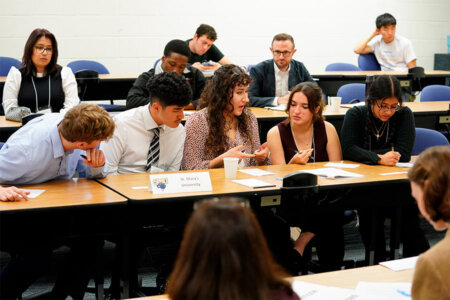
Participating in the 28th annual Texas Regional Ethics Bowl in the University’s Albert B. Alkek Business Building in November, the match was one of three in which Davey and her team participated. Since its inception, the Ethics Bowl has been sponsored by the Center for Professional Ethics under the Department of Philosophy.
For several years, the Ethics Bowl has been the Center’s only event, said Andrew Brei, Ph.D., Associate Professor of Philosophy and Director of the Center for Professional Ethics. But Brei sees greater opportunities.
Ethics deals with moral principles and how those govern people’s behaviors. Brei took over the position from Robert Boyd Skipper, Ph.D., Professor Emeritus of Philosophy.
Brei is currently exploring ways to incorporate ethics into different fields of study. He invites University students to engage with ethics beyond their required Core Curriculum course.
In Fall 2025, the Center for Professional Ethics cosponsored a table discussion with the University’s Esports team, topics ranging from video games to music. He’s also helping lead ethical discussions about the use of AI.
“I want there to be opportunities where I can support other programs,” Brei said.
Davey and her team placed eighth out of 14 teams, winning two of their three matches; their final position determined by their overall point total.
The experience is a reminder to Davey about why it’s important to find ways to continue exploring ethics beyond the classroom.
“It’s important to expand our knowledge because it helps us understand what it means to build a good society,” she said.
Expanding ethical discussion
At St. Mary’s, students are required to take one Ethics course as part of the Core Curriculum — a set of required classes all students must take, regardless of their major.
Outside of that course, a class on ethics in career-specific areas is not mandatory or offered. Brei sees opportunities to bring more ethical discussions to campus.
“In the Intro to Ethics course, you can’t spend a lot of time dealing with the issues that come up in medical professional contexts, forensic science or environmental science,” he said.
Brei is also working on a new book about the ethics of travel, exploring areas of language, history, culture and behavior.
“I know ethics can come off heavy-handed, but I don’t want that to be the case,” he said.
Ethical debate
Davey never participated in debate in high school, but she knew she wanted to be involved with ethics.
Instead of memorizing a speech and presenting it during debate, the Ethics Bowl gives her a chance to make arguments on a subject off the cuff. She’s been with the team since her first year at the University.
“It tests not just your public speaking skills but also your ability to fully understand something to the point where you can talk about it at length without really any preparation,” she said.
Emily Davey“Ethics is not the philosopher in his ivory tower overlooking the world and judging. It’s intertwined with so many avenues. There is so much more it can do to help our understanding of what is good and just in a variety of areas.”
In addition to practice, the team meets on Fridays, discussing myriad topics from current events to holiday-related discussions (like during Halloween, when the group discussed what a soul was and if ghosts exist).
For Davey, expanding opportunities to explore ethics makes sense. It is more than exploring the studies and thoughts of people from dusty tomes.
“Ethics is not the philosopher in his ivory tower overlooking the world and judging,” Davey said. “It’s intertwined with so many avenues. There is so much more it can do to help our understanding of what is good and just in a variety of areas.”