
Learning while helping
by Catherine Deyarmond
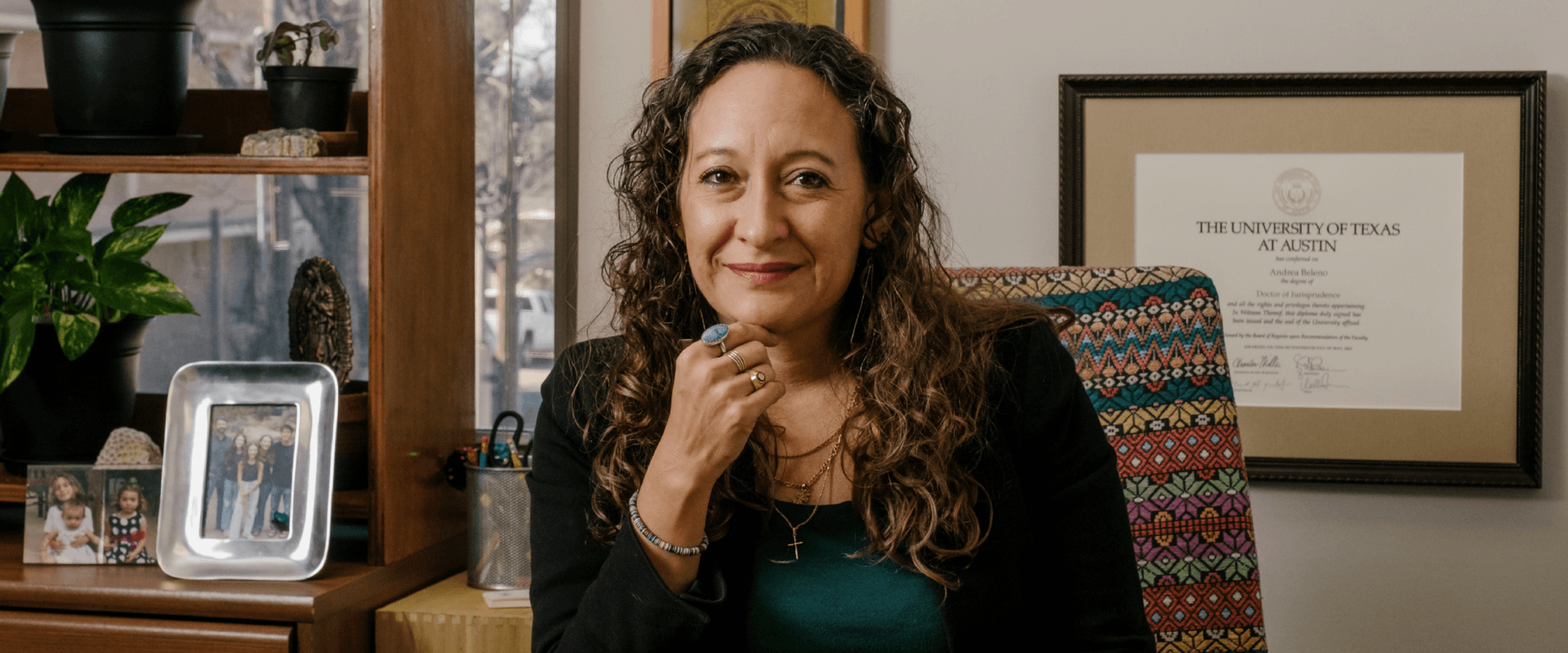
After 22 years providing legal services to the underserved at Texas RioGrande Legal Aid in Austin, Andrea Beleno Harrington, J.D., couldn’t pass up the opportunity to create the new Microenterprise and Community Development Clinic at the St. Mary’s University School of Law.
The clinic is part of the Bennie W. Bock II Center for Business and Transaction Law, which was established by a $5 million gift to the University from the Oatman Hill Foundation. The foundation was created by the estate of Bock, a 1968 J.D. graduate who died in 2022.
The Microenterprise and Community Development Clinic is a transactional practice giving students the opportunity to provide legal assistance to microbusinesses and community-based nonprofits. Microbusinesses are companies with nine or fewer employees generating less than $250,000 annually.
“It was serendipitous,” said Harrington, who specializes in small business and community development matters. “It was a blessing, and a door opened that I had to step through.”
Harrington, a Clinical Assistant Professor of Law, said she grew up watching her mother and other Colombian Americans choosing “entrepreneurship as a way to achieve economic stability when their education, language proficiency or life circumstances, which could involve caring for their elders or children, did not allow them to have a regular job that paid a living wage.”
“An important part of having a vibrant, healthy and functioning community is for residents to have access to services provided by microbusinesses and nonprofits,” she said.
A new start
Harrington, who joined St. Mary’s in July 2025, spent the Fall 2025 semester developing the curriculum and networking with community contacts. Two fellows from the Texas Immigration Law Council’s Economic Justice Initiative are helping get the clinic up and running.
“The fellows are conducting community outreach, educating the public about the availability of clinic services and establishing relationships with community organizations serving limited-income individuals, who can refer to us clients in need of our assistance,” said Karen Kelley, J.D., Assistant Dean for Clinical Programs and Clinical Professor of Law.
“Law students demonstrate in practice their legal skills to help vulnerable people. Students are learning valuable skills while truly making a difference.”
— Andrea Beleno Harrington, J.D.
The clinic is important for students because the other clinics are primarily litigation-based, she said. It is St. Mary’s Law’s sixth clinic, housed in the Center for Legal and Social Justice building.
“Litigation-related courtroom skills are very important for law students,” said Kelley, an Englehardt Research Fellow. “However, many students also are interested in transactional practice areas or could be if they had the opportunity to learn more about those practice areas.”
Needed legal services
Students will have an opportunity to practice transactional skills — including contract drafting, business entity formation and client advising regarding compliance with the various regulations that apply to a particular type of business.
“Our students will still receive training in many skills that overlap with and would be transferable to a litigation practice as well, including client interviewing, client relationship-building, fact gathering and legal and factual research,” Kelley said. “That we are able to conduct both the instruction and the casework of the clinic fully online is of great benefit to our online students.”
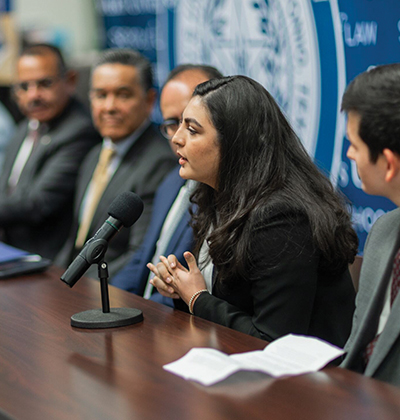
In the Spring 2026 semester, Harrington began her course with the first cohort of students. With her providing faculty supervision, second- and third-year J.D. students, who work in pairs, were assigned clients.
Harrington said the clinic fits squarely into the Marianist mission of assisting the community by educating for service, justice and peace.
“Law students demonstrate in practice their legal skills to help vulnerable people,” she added. “Students are learning valuable skills while truly making a difference.”