
Science rocks!
by Nathaniel Miller
It came from outer space. At some point.
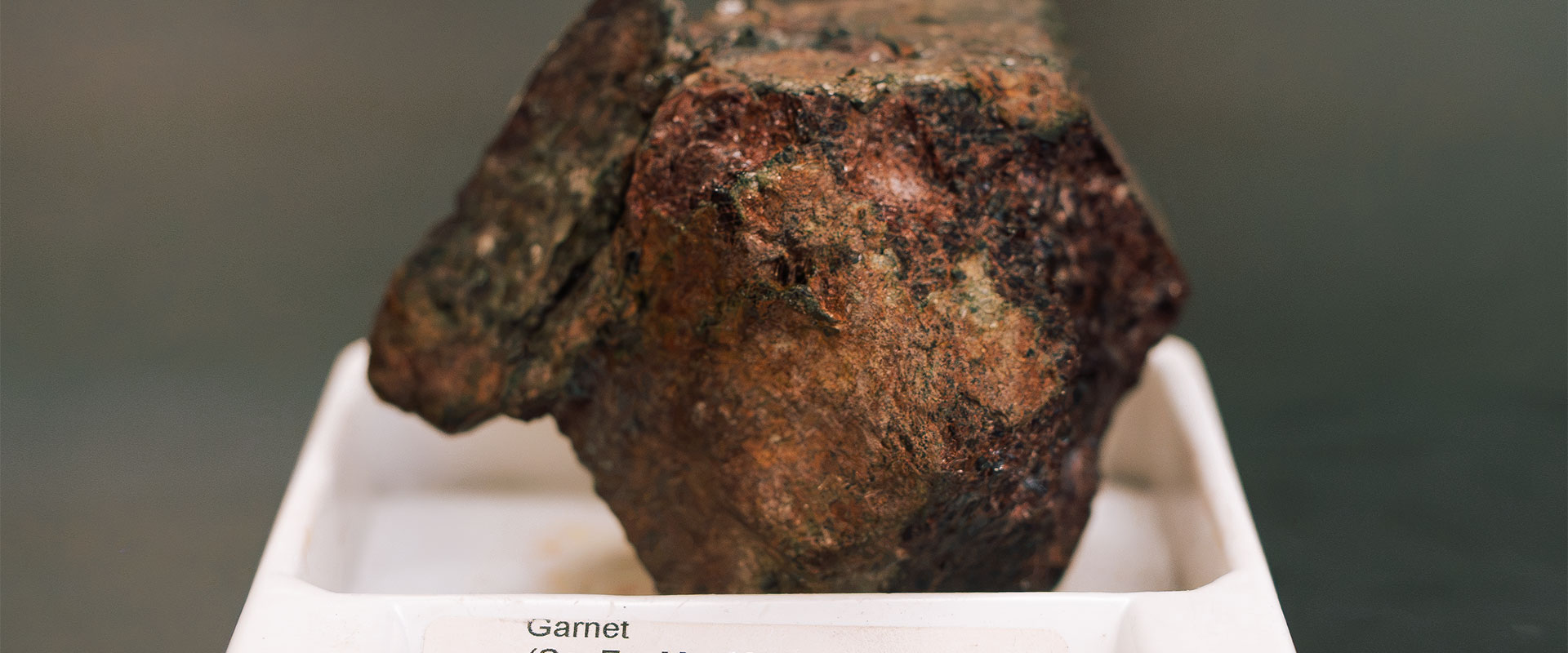
Scientists have recently discovered a garnet, about the size of a poppy seed, inside a meteorite that came to Earth from Mars. Garnets are commonly found on Earth; however, the right set of conditions for garnets has never been identified on Mars.
The meteorite, saucily named NWA 8171, was discovered in 2013, but the minerals were not discovered inside the space rock until June 2026. The recent discovery has the scientific community asking how and why the minerals formed.
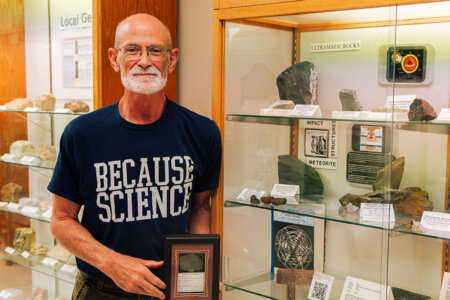
St. Mary’s University Professor of Environmental Science (and rock star) David Turner, Ph.D., talks with Gold & Blue about why the finding is significant, and how he uses one of his classes to discuss the similarities and differences of the terrestrial planets in our solar system.
Q: What is a garnet?
A: Garnets are a type of mineral. They’re made of silicon and oxygen and some other elements from the periodic table are put together, and they’re relatively common minerals you can find on the surface of the Earth.
Garnets are semi-precious gemstones, and they have a very distinctive crystal shape. They have 12 faces on them, which is called a dodecahedron. It looks like a soccer ball, and you can find them as small as the ones from Mars, or you can find them bigger. I have seen garnets as large as bowling balls.
Q: Why is the finding of a garnet from a Mars meteorite significant?
A: To my understanding, this is the first time a garnet has been found on any rocks that are believed to come from Mars. We don’t have a lot of direct samples from Mars, so our understanding of the mineralogy of the planet is still developing.
Because garnets on Earth are metamorphic minerals, it means they undergo a change in form or structure under specific conditions, such as high heat and intense pressure. The Mars garnet suggests that metamorphism (the transformation of existing rock to rocks with a different mineral composition or texture) may have occurred on Mars.
It’s of interest because it opens up a bunch of possibilities for how the minerals and the rocks on Mars may have evolved through time.
Q: What is the difference between an Earth garnet and the Mars meteorite garnet?
A: Most of the garnets you can find on Earth are big samples. There are a lot of metamorphic rocks around on our planet, and a lot of them have garnets in them. It’s a pretty common mineral.
Right now, we have exactly one sample for Mars, and so the main difference is the abundance.
Q: Does this mean there are more geological similarities between Earth and Mars?
A: That’s the million-dollar question.
Because we live here and we have access to it, we know a lot more about the evolution of Earth. Mars is a different planet, and it’s had different systems and situations, and so what this garnet might point us to is not necessarily how Mars is today, but how Mars might have been in the past.
One aspect of this discovery is that a lot of garnets form when there’s water. That’s what we’re always looking for on Mars, the indication of water.
It’s a dry planet now. There are no surface oceans. But if it’s our nearest neighbor, if there’s a planet in the universe that we’re likely to visit, it’s going to be Mars. Water is something that we would need to visit Mars.
Q: How do rocks and minerals help tell the history of a planet?
A: For any planet like Earth, we call them terrestrial or earth-like planets. Rocks are the history of the planet. It’s how we’ve understood mineralogy and the understanding of how minerals form and how they evolve over time.
Q: Does the David J. Fitzgerald Museum of Earth Sciences in Garni Hall have any exhibits that help tell the story of geology on other planets?
A: We have one meteorite that was found in Namibia, Africa, back in the 1830s, and it’s a beautiful sample. We also have some that show evidence of meteorite impacts.
These samples can be used to help understand the history of the solar system. Meteorites formed at the same time as the planets, and that’s one of the ways that we understand our own planet.
Q: Do any of the geology classes at St. Mary’s touch on the geology of the other terrestrial planets in our solar system: Mars, Mercury and Venus? If so, how is that part of the curriculum, and why might it be important to understand other worlds?
A: I cover planetary geology in the general geology class. One of our learning objectives is to understand the age of our planet and its place in the solar system. I bring in our nearest neighbors, Mars, Mercury, Venus, the four innermost planets, because they’re similar to Earth.
The other way that I use it, particularly with Mars and Venus, is because we can use them as analogs for Earth. Their atmospheres are very different from Earth’s, but we can look at those nearest neighbors and get a sense of what can happen if atmospheric conditions change substantially.
Well, if you have a runaway greenhouse gas effect, you end up with Venus, which is 500 degrees centigrade warmer. On Mars, you have too little atmosphere, and it’s not warm enough for liquid water today.
Earth is often referred to as the Goldilocks planet, where it’s close enough to the sun but not too close, has enough atmosphere, but not too much. What is important from an evolution of life perspective is keeping the temperature above the freezing point of water. You can have liquid water, then life can find a way.