
Behind the numbers
by Nathaniel Miller
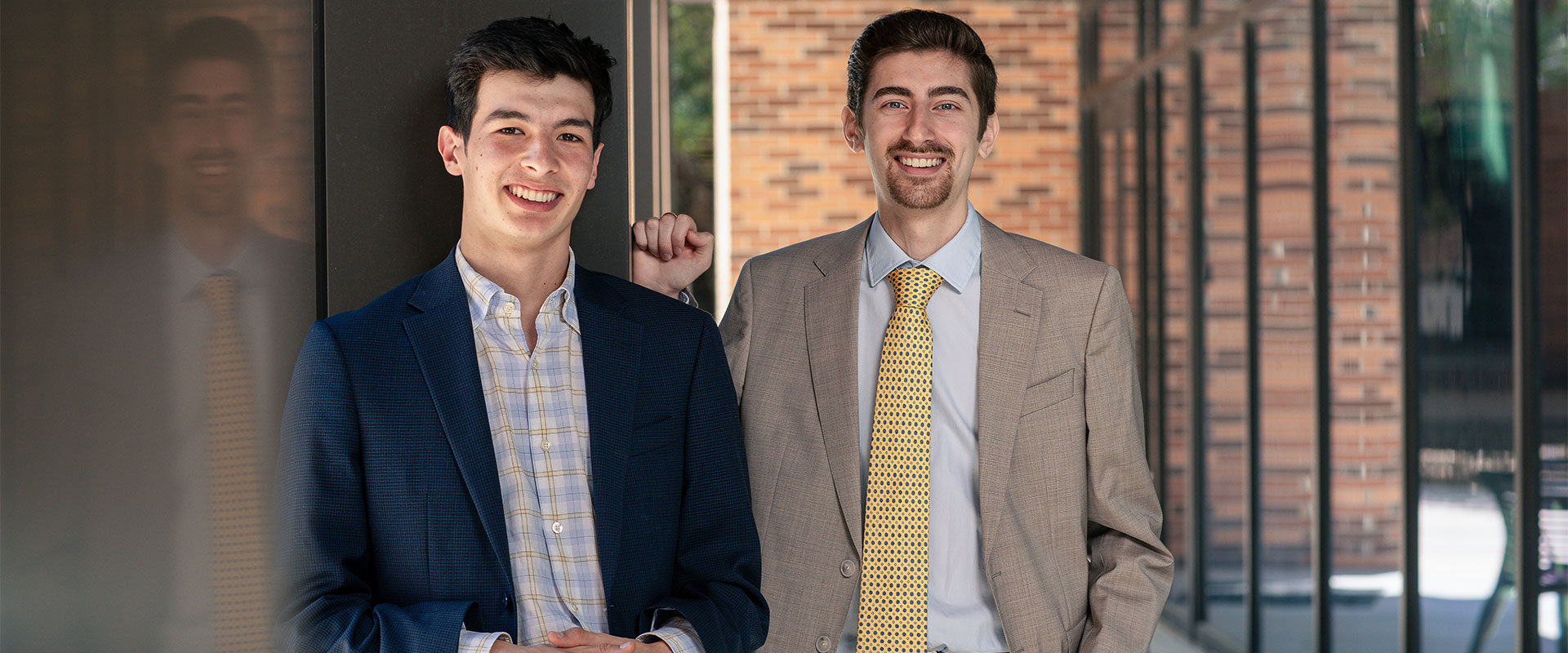
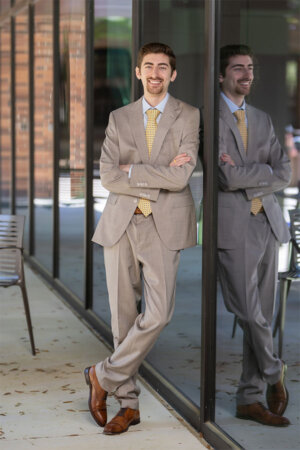
Maroun Harb (B.B.A./B.S. ’23) doesn’t have a crystal ball, but he still tries to predict the future.
As an actuary working with the capital modeling team at USAA, Harb uses math, statistics and other tools to help manage risk and set premium prices for customers based on data.
Simply put, Harb and other actuaries estimate long-term levels of damage to set premium prices for insurance customers and help those same companies set reserves — money used to pay client claims.
Much like weather forecasting, it uses models to make predictions. Harb said the job can sound boring to some, but there’s more to it than people think.
“What I enjoy the most about it is the fact you need to know a little bit about everything,” Harb said. “When you’re studying actuarial science, you have to be dedicated to learning in general.”
The Bachelor of Arts in Mathematics with a Concentration in Actuarial Science is one of four math degree options offered at St. Mary’s University.
While there is no specific accreditation offered for an actuarial program, the national Society of Actuaries recognizes St. Mary’s in its Universities and Colleges with Actuarial Programs.
Harb, who was already familiar with St. Mary’s because he would visit campus with his sister, Crystel Harb (B.S. ’14), knew he wanted a career in mathematics. As part of the curriculum, courses such as Principles of Finance and Fundamentals of Risk Management are required.
Those courses led him to his second major, Finance and Risk Management, to help him get the most out of his degree.
“You could really take this area of study and run with it in whatever you’re interested in,” Harb said.
Actual actuarial classes
Jason Shaw, Ph.D., was in his second year of teaching at St. Mary’s when Winston Erevelles, Ph.D., then-Dean of the School of Science, Engineering and Technology, pulled him aside and tasked him with creating an actuarial science program.
Shaw, along with the Mathematics Department, didn’t just look to put a curriculum together; they went out to talk to the experts about what students would need to be successful.
“We got industry input and asked, ‘What do you think we would need to make students successful?’” Shaw said. “We were talking to actuaries and to insurance companies, and they gave us a great idea of where to start.”
The foundation of the actuarial program, in addition to the University’s core curriculum, includes 45 hours of mathematics — such as statistics, probability theory and calculus — and 33 hours of actuarial science courses.
According to the U.S. Bureau of Labor Statistics, the job outlook for actuaries is expected to grow 22% over the next 10 years. Additionally, the Bureau states that the median annual pay is $125,700.
Not everyone who pursues a degree in actuarial sciences starts as a math major, Shaw said. Many students find their calling in other areas, many realizing they enjoy math.
“Actuarial science opens up a doorway many didn’t know existed,” Shaw said.
Already ready
When Roland “RJ” Rojas was a student at Central Catholic High School, he already knew he was going to St. Mary’s.
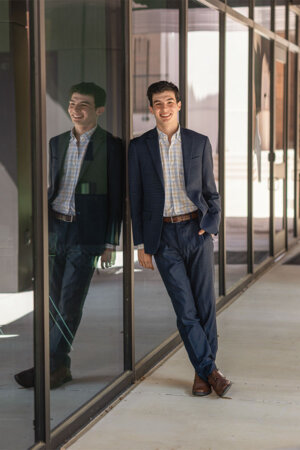
His father, Roland Rojas (B.S. ’95) and twin sisters, Liliana Rojas (B.B.A. ’24) and Olivia Rojas (B.S. ’25), are alumni.
As someone who likes to work on cars and use his hands to build things, he initially planned to study Mechanical Engineering. During his freshman year, he had a change of heart. That’s when Liliana Rojas told him to look at insurance.
“I reached out to an old neighbor who was an actuary, and I reached out to Maroun because he was a friend of my sister’s and is an actuary,” RJ Rojas said. “I learned there’s so much about actuarial science that I just didn’t realize.”
The junior has since gone on to compete in a case competition — academic events in which teams of students analyze complex, real-world business scenarios — at the University of Texas at Austin and has an internship with CSAA Insurance Group during the summer. It’s a field RJ Rojas calls a “hidden gem.”
“Everyone has insurance, and everyone’s getting a price,” he said. “You’re all getting this information from a group of people that almost nobody knows exists.”