The salamander whisperer
by Nathaniel Miller
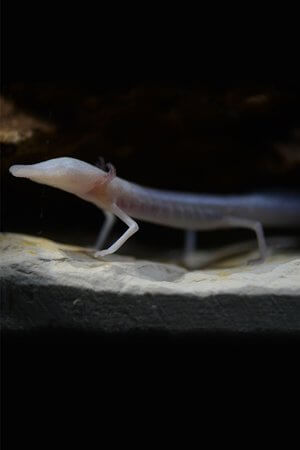
Specific to Central Texas, there’s a species of animal that grows a few inches in length and weighs only a few grams. They live in underground, water-filled caverns and in almost pitch darkness.
Their habitat affected their evolution, leading them to develop optic nerves, but no functioning eyes. Their pale, transparent and slippery skin can make them appealing — maybe even adorable — to some.
The animals in question, the Texas and Austin blind salamanders, are of the Eurycea genus. Despite their lack of functioning eyes, they could be the key to better understanding congenital ocular disease in humans.
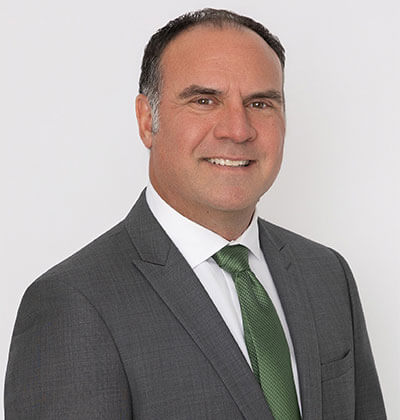
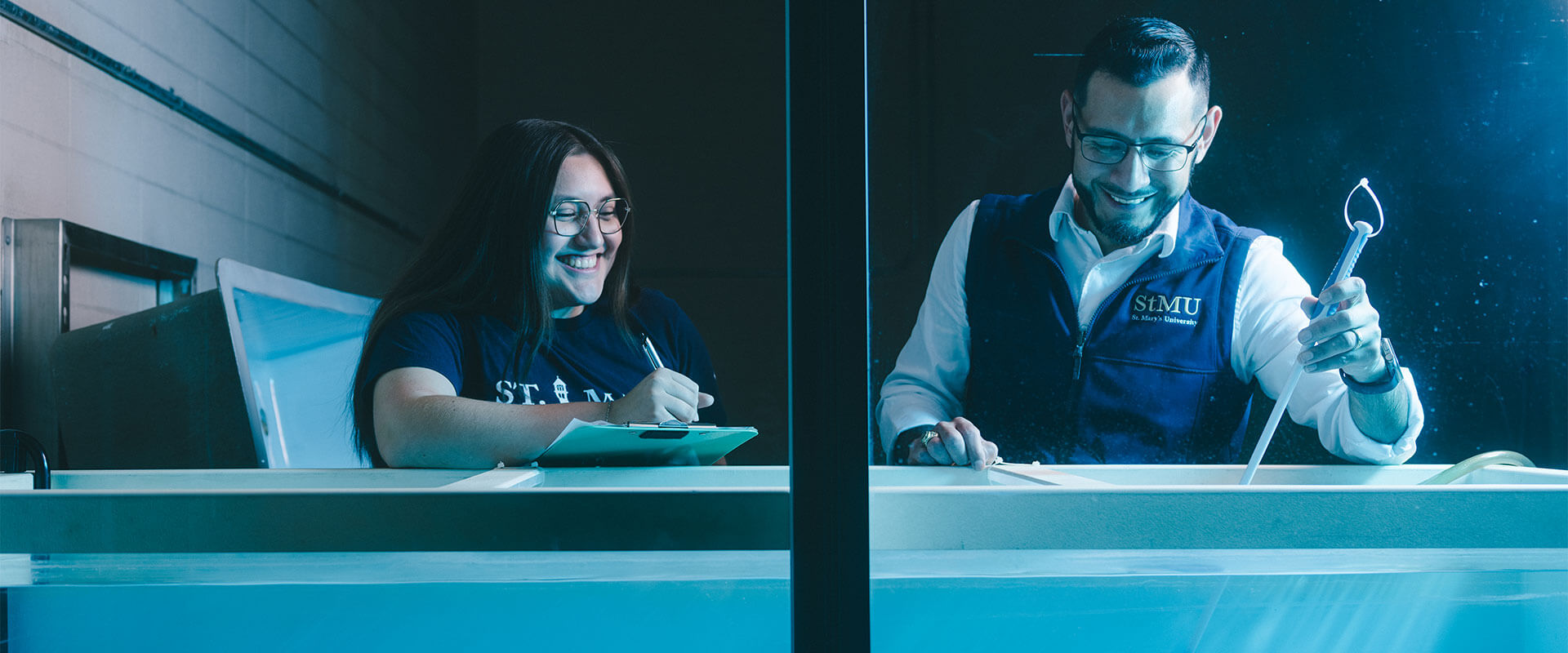
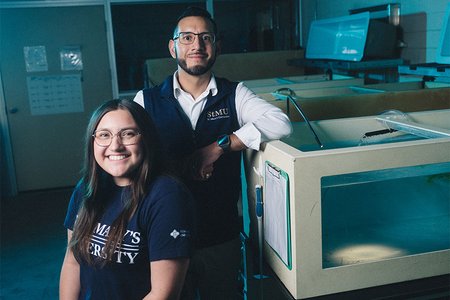
Assistant Professor of Biological Sciences Ruben Tovar, Ph.D., who has studied the salamanders since graduate school, brings his knowledge and research to St. Mary’s University. His lab, while not technically a cavern, is set up as close to an underground cave as one can get on campus — the basement of the Moody Life Sciences Center.
Tover’s research also means St. Mary’s will be the only Texas university to have and maintain a diverse population of salamanders — three groups from the Guadalupe River State Park area and one from Helotes Creek Springs.
The closest set-up would be the San Antonio Zoo and the U.S. Fish and Wildlife Service’s San Marcos Aquatic Resource Center, which focuses on salamander habitat conservation.
“This has been my jam since I started grad school,” Tovar said.
Shining a light in the darkness
During his senior year as an undergraduate at the University of Texas at Arlington, Tovar took an Evolutionary Development Biology course that sent him to a world of darkness.
He learned about a blind fish in Mexico that was invading caves and how its body had adapted to total darkness.
As a San Antonio native with a love of reptiles and amphibians, Tovar wondered if a similar study had ever been completed on the blind salamanders in Central Texas.
The answer was no.
Both are listed as threatened species, with the Texas blind salamander being listed as endangered, two steps away from extinction.
“It’s illegal to have them without permits,” Tovar said.
The research became his focus of study during his graduate and doctoral studies. The salamander populations set up in the lab are the same ones he studied at the University of Texas at Austin.
As tetrapods — four-footed and having a backbone — the salamanders and humans share a common ancestor. This connection may help treat human diseases.
“When we think about them not developing an eye as an adaptive feature, this can tell us how human ocular development is supposed to go,” Tovar said. “The goal here at St. Mary’s is to elevate my research toward thinking about human congenital ocular diseases and how these salamanders might give us a glimpse into gene expression through development.”
Helping hands
While continuing his work, Tovar will not be alone.
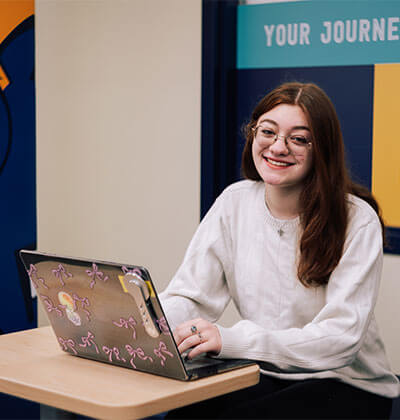
In Fall 2026, St. Mary’s University Biology student Rubi Mendez returned to the lab after a summer at Stanford University. She was able to attend the West Coast institution through the Summer Undergraduate Research Experience offered by the Howard Hughes Medical Institute.
At Stanford, Mendez worked with other undergraduate, graduate and doctoral students to isolate and study degraded DNA from fecal samples of the black-footed cat.
In Fall 2025, Mendez did histology work in Tovar’s Cellular and Molecular Methods class, preparing, processing and staining tissue samples for ocular research. Continuing the work in Spring 2026, Mendez and her partner presented their findings at the Texas Conservation Symposium.
“It feels rewarding to take what I learned from his class and expand on it,” said Mendez, who hopes to become a research scientist. “I’m really excited to see how much more we can progress on this project.”
Tovar also encouraged Mendez to apply for a grant with Sigma Xi, a nonprofit honor society for scientists and engineers, for which she was awarded $2,432 to use during the fall.
In a mentor role, Tovar hopes to continue his own research while finding ways to guide new students in their own educational journey.
“I try to take special care in developing a mentoring plan for Rubi because it meant a lot to me when I was getting mentored,” Tovar said. “I’m trying to prepare her for the next step.”