

January 5, 2026
A collaborative effort of St. Mary’s University students and alumni — supported by an associate professor of Biology — published a peer-reviewed article in December about microplastics affect lifespan and fertility; a result from a four-year grant awarded to the University in 2024.
The article, Microplastics-Mediated Delivery of Di-butyl Phthalate Alters C. elegans Lifespan and Reproductivity Fidelity, appeared in Microplastics, an international journal published by the Multidisciplinary Digital Publishing Institute.
In the article, the group from St. Mary’s found that microplastics — plastic debris that degrades into smaller and smaller pieces and reported by scientists to already be found in the human body and blood — mixed with other toxins, specifically di-butyl phthalate, significantly affected the microscopic worms the team observed.
Di-butyl phthalate is used as a plasticizer and a solvent in products such as adhesives, paints and cosmetics.
“Microplastics and toxins themselves can have detrimental effects, but the two together are worse than each of them individually,” said Jennifer Harr, Ph.D., Associate Professor of Biological Sciences and Director of the Forensic Science Program in the School of Science, Engineering and Technology. “When combined, the polystyrene microplastics and the di-butyl phthalate led to significantly reduced lifespan and significantly reduced reproduction in the worms.”
The research was conducted using C. elegans, a microscopic worm and model organism for human development, health and disease because of its high genetic similarity with humans.
Using a $669,951 grant from the National Institutes of Health awarded in 2024, Harr researched how exposure to environmental chemicals, such as pesticides and plastic additives, when combined with microplastics, can damage DNA, development and health.
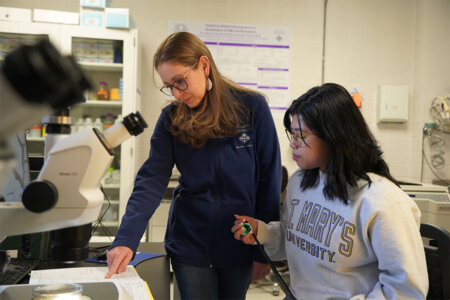
St. Mary’s promotes transformational, hands-on learning through research and creative scholarly activities for faculty and students at the graduate and undergraduate levels.
“We really emphasize that students should get involved in independent research because it gives them an outlet and way to make connections between what they’re learning in the classroom scientifically and what you can do as a scientist,” Harr said.
Chiara Maldonado, a Forensic Science – Biology Track major who is listed as the first author on the article, praised the teamwork of her lab partners, Harr’s leadership and the ability to publish research at an early stage in her education. In research, the people who perform the majority of the research are typically listed as the first authors on the article.
“That paper is our blood, sweat and tears,” Maldonado said. “It’s astounding that, despite being undergraduates, we were able to push this paper out. It’s not just about our lab; it’s also representing our University worldwide.”
Research reported in this press release was supported by the National Institute of General Medical Sciences of the National Institutes of Health under award number R16GM150406.