
The liberal arts of AI
by Nathaniel Miller
The rise of artificial intelligence brings questions about its impact on humanity and faith.
Is the new technology a form of God’s inventions? If so, how does it fit into the mission of Catholic teachings and Marianist campuses?
This fall, Pope Leo XIV called on Catholic universities to be the center of “the combined effort of intellect and faith” that enables people “to reach the full measure of their humanity.”
Now, artificial intelligence is sparking fresh quests to integrate knowledge and faith through technological advances at St. Mary’s University.
Pope Francis also briefly touched on the topic in Antiqua et Nova — a doctrinal document of the Catholic Church addressing the issue of AI and human intelligence. Francis urged readers to view the technology as an artificial form of human intelligence rather than a product of it, making it a part of God’s overall design.
Many professors have already begun incorporating AI into their curriculum. Early adopters have even created classes on using and viewing it in ethical ways.
“It’s touching every facet of what a university does,” said Jason Pierce, Ph.D., Provost and Executive Vice President for Academic Affairs, “AI has really exploded in terms of the complexity and the number of issues we as a University need to address.”
Pierce has tasked a group to bring forth ideas on how to address this technology and create a University-wide policy addressing topics ranging from appropriate use by students, how AI will advance and protect work connected to academic scholarship, and how it can be used without violating federal privacy laws around health and educational data.
St. Mary’s is also actively exploring AI’s use as it affects the environment, in line with its commitment to Laudato Si’ — Francis’ encyclical on the moral and theological reasons for caring for the Earth.
Pierce asked Lecturer of History Bradford Whitener, Ph.D., and Professor of Mathematics Paul Uhlig, Ph.D., to lead a working group in Fall 2023. The recommendations from their initial report, released in October 2025, have led to the creation of a steering committee and various subcommittees.
In December, the committee’s report was presented to the University’s academic community. Similar meetings with the rest of the community will also be scheduled.
The policy’s goal is to continue allowing professors academic freedom in their approach to AI.
“We’re starting to get a narrative about how we are going to talk about AI as a part of who we are as an institution,” Pierce said.
The age of average is over
It was December 2023, before being officially asked to create a working committee, that Uhlig and Whitener began researching the rapid advancements in AI.
Faculty turned out in large numbers for an open forum pondering the question: How would students use AI to avoid doing course work?
“We were expecting AI to be available to students,” Uhlig said. “Questions were along the lines of ‘How do we defeat it?’ which turned into things like, ‘How do we detect it so that we can penalize its use?’”
The concerns are valid, Uhlig said. However, both he and Whitener saw AI in another light: affecting future vocations, maximizing its potential in the classroom to give students an edge and aligning with the Characteristics of Marianist Universities.
Denada Ibrushi, Ph.D“The true power of AI in education lies not in replacing human wisdom, but in amplifying it, guided by purpose, ethics and service, which are key components of our mission at both the Greehey School of Business and at St. Mary’s.”
While the number of job listings requiring experience with AI remains low, it has increased.
Between 2010 and 2025, the number of AI-specific job postings rose by about 29%, according to Brookings Metro. Data shows only 9% of United States businesses are using AI in their daily operations.
A joint working paper between researchers at Harvard Business School and the Wharton School at the University of Pennsylvania found that people using AI finished 12% more tasks on average, completed tasks 25% quicker and produced 40% higher quality results than those without.
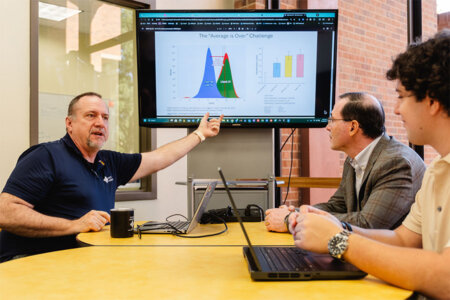
Whitener said AI can be seen as the new Industrial Revolution, changing the world at a rapid pace. Uhlig calls the age of average “over.”
“The reality is that AI is here, and students are going to be using it,” Whitener said. “It’s a radically different tool than what we’ve ever had in our toolbox.”
There have also been discussions on the environmental aspects of AI use.
Professor of Environmental Science David Turner, Ph.D., said, on average, a home in the United States uses about 10,000 kilowatt-hours of electricity annually. Training ChatGPT 4 — the time required to make it a usable tool — took about 50 million kilowatt-hours, enough to run about 5,000 homes. A billion text queries, which is an average day’s worth, uses about 2,000 kilowatt-hours.
An AI session generating 15 text queries, 10 video images and three five-second videos would use enough energy to run a microwave for three-and-a-half hours, Turner added.
While not against the use of AI, he believes that it’s imperative to consider what it takes to run such programs.
“AI is certainly a transformative technology, but it comes with an environmental cost that is not always fully recognized,” Turner said. “Helping the members of our community understand these costs as St. Mary’s continues to explore the role of AI is an important part of maintaining our commitment to the principles of Laudato Si’ as we work together to make a more sustainable University.”
Rattlers lead the way
As AI technology advances, so do the risks associated with its use.
AI uses a process called machine learning, which involves collecting and practicing with data, using patterns to respond to commands and improving over time.
These improvements come as companies create their own platforms, in addition to those for public use. For institutions that must comply with federal privacy laws, AI use can be problematic.
St. Mary’s is exploring how to offer these products in a way that is safe for students, faculty and staff.
The University is launching a partnership with nebulaONE, a multi-modal interface that integrates with the campus environment while ensuring compliance with relevant privacy laws. The pilot program, called Rattler AI, will begin in January 2026.
The program will be accessible through the University’s intranet. Part of the draw is the control and security offered by its company, Cloudforce.
“We need to address AI because if we don’t, in another year, we’re going to get behind,” said Curtis White, St. Mary’s Vice President for Information Services. “We need to get things in place, so our folks don’t make a mistake and put sensitive data in a place where it doesn’t belong.”
AI on the defense
Ayad Barsoum, Ph.D., Professor of Computer Science, sees AI as no different than a knife.
“You can use a knife for good things because you have ethics and you have values,” said Barsoum. “The same principle applies to artificial intelligence; it’s a powerful tool that can be used for good or misused to cause harm.”
In the world of cybersecurity, being able to defend against attackers is critical. A cyberattack in airports across Europe in September 2025 delayed and canceled multiple flights. AI has also been used to attack electrical grids and steal information from corporations.
It’s not just about understanding how technology is enhancing the world of cybersecurity. It’s also about understanding the basics and how AI is utilized, while also avoiding overreliance on it.
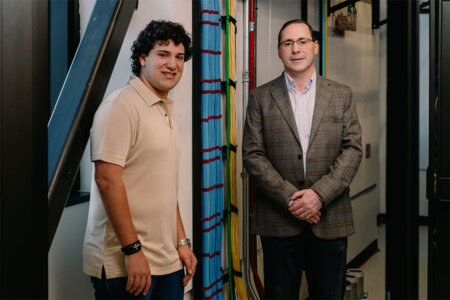
The invention of the calculator, Barsoum said, did not change math. It helped make calculations quicker. But tools don’t work unless you know why and where answers come from.
“This is the concept I want to instill in my students,” he said. “Using AI effectively requires combining it with your own reasoning, background and knowledge; that’s what makes you truly capable.”
Student Juan Marco Saca Dada believes AI is a great tool for research and managing tasks. The junior from El Salvador, who is currently in the Combined Bachelor’s and Master’s Degree program majoring in Computer Science and pursuing a graduate degree in Cybersecurity, first encountered AI in high school in 2022.
Saca Dada uses ChatGPT as a sounding board for ideas when looking for paper topics. He also watches videos on YouTube, returning to AI for help in breaking down complex ideas.
During group projects at St. Mary’s, Saca Dada uses AI to help divide work, shortening preparation time and allowing teammates to quickly start their portions.
In cybersecurity, he sees AI as both an asset and a threat.
“It can become a threat to security with how hackers can attack others, but in the same way, we are using it to defend systems and detect those threats,” he said.
Analyzing the business of AI
When Denada Ibrushi, Ph.D., NuStar Professor of Finance, gave her students a prompt to put into ChatGPT, she already knew the answer was wrong.
That’s because she wrote the prompt in a way that would give her students an incorrect answer.
“This way they’re aware they shouldn’t blindly trust AI, and they’re building the skill of prompting and entering accurate information to arrive at a correct answer,” she said.
As AI continues to make strides in the business world, students at the Greehey School of Business are expected to adapt.
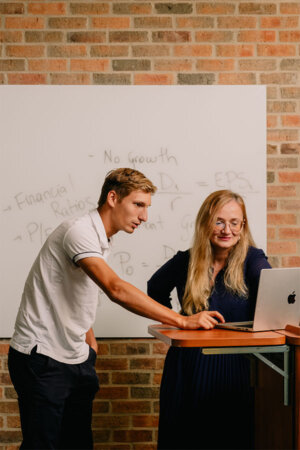
Ibrushi said businesses are using AI in ways that help them assess risks, quickly search and summarize business articles, and easily access information before acting on stocks.
One student’s internship, she added, included using AI to analyze customer data and feedback to enhance customer service and marketing.
That does not mean the machines are taking over anytime soon.
“AI is a people pleaser that often produces responses designed to satisfy the user rather than ensure accuracy,” Ibrushi said. “It’s our job to question its validity.”
International student Bernhard Hauer wasn’t familiar with AI before arriving at St. Mary’s in 2022 from his home country of Austria.
The senior Finance and Risk Management major was accustomed to studying on his own in Vienna.
When he was shown AI and told of the benefits, he found it refreshing to have a new way to help him study.
“Now, I use it daily,” he said.
Like Ibrushi, Hauer has taken a cautious approach when using these tools. There have been times when he has received incorrect information or fabricated sources.
He doesn’t expect machines to replace humans, but he agrees the technology will change the workforce.
“It doesn’t matter what industry or business is using AI,” Hauer said. “But learning how to use it and how best to ask it questions is giving us an advantage over schools that don’t utilize it.”
To ensure their training is up-to-date, St. Mary’s instructors continue to find ways to incorporate AI into their lessons.
To do this, the School of Business has brought industry experts to further explain how courses can be enhanced.
“The true power of AI in education lies not in replacing human wisdom, but in amplifying it, guided by purpose, ethics and service, which are key components of our mission at both the Greehey School of Business and at St. Mary’s,” Ibrushi said.
Viewing AI through the human lens
Julia Camacho has never spoken to Edwin Stanton. He’s been dead for more than 150 years. Nor is Camacho a musician in the typical sense. But that didn’t stop her from putting together a rock music track about the former U.S. Secretary of War refusing to vacate his office.
During one of Whitener’s History courses in Fall 2024, the instructor tasked students with selecting one of several AI tools to research and create a project around a historical figure. The catch? It had to be something different than reading a book and writing a paper.
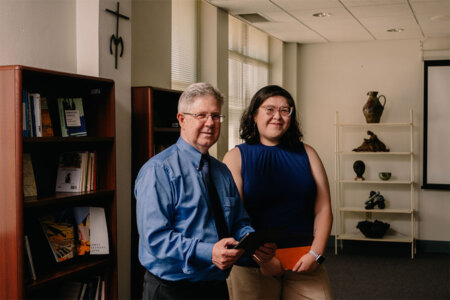
“I was kind of taken aback by the assignment,” Camacho said. “But when Professor Whitener explained his reasons behind it, I really liked his approach.”
As an early adopter of AI, Whitener views it as a way to promote active learning, getting his students to become more engaged in their history classes.
Using various AI models, Whitener had his students simulate interactions with major historical figures. Students were then able to create podcasts, music videos or other projects not previously possible.
“This kind of assignment gives students a chance to practice using AI in a way that will benefit them, not only for this class, but for any class,” Whitener said. “If they know how to use it in this way, that’s a major difference in approach to AI.”
It’s not just about using AI but seeing it through the lens of the humanities.
Benjamin “Josh” Doty, Ph.D., Associate Professor of English Literature and Language, led a graduate-level course in Spring 2025 called Introduction to the Digital Humanities: AI and Culture.
Covering reading material dealing with the ethical and cultural dilemmas of AI, it was also a way to offer new insights into storytelling, ethical dilemmas and cultural production.
Doty and his students explored how people interact with technology in a way that countered the typical horror-driven scenarios seen in robot movies.
“I wanted to flip the script and ask the questions that we ask in the humanities about what is a good life, what does it mean to be a human being, what good is culture and how do we, overall, approach AI from the toolkit that we have in the humanities,” Doty said.
The continued use of AI and how it will affect the future isn’t known. But St. Mary’s students, including Camacho, believe the technology is here to stay.
“By not using AI just because you don’t like it, you’re setting yourself up for failure,” Camacho said. “St. Mary’s has always been about encouraging their students to change the world.”