

Master of Science in Computer Engineering
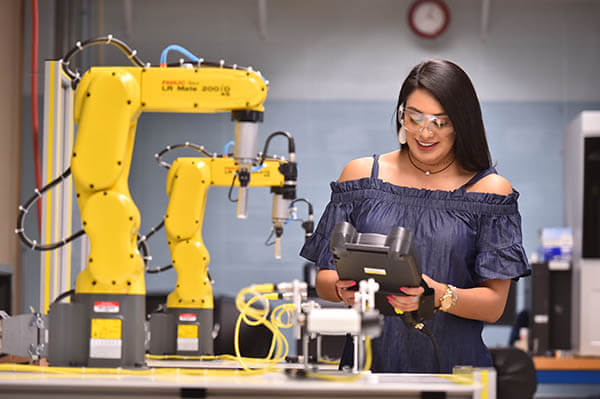
Students completing the M.S. in Computer Engineering are prepared for highly technical positions generally having to do with electrical and computer equipment and systems. Graduates can be involved in fields such as computer networking, communications systems, integrated systems, fiber optics, microprocessors, robotics, software design, embedded systems, computer architectures, digital systems design, and electronics.
The department also offers a unique five-year combined Bachelor of Science and Master of Science in Computer Engineering. Undergraduate students begin graduate course work during their senior years and pursue a master's degree in one year.
To apply online, click here. For more information about the graduate school, click here.
Contact Information
For further information, please contact Djaffer Ibaroudene, Ph.D., Graduate Program Director, at (210) 431-2050 or dibaroudene@stmarytx.eduProgram of Study
Graduate Program Directors assist the student in designing a Degree Plan which meets university requirements. All courses must be approved by the Graduate Program Directors. Students may elect a 30 hour thesis or 30 hour non-thesis program. The 30 hour thesis program consists of 27 hours of course credit in addition to 3 hours of thesis credit, EG 6339 Thesis Direction. Non-thesis students must complete 30 hours of course credit and a special project combined with an oral comprehensive examination. The General Examination for thesis students is oral.EG 6328 Software Engineering
EG 6356 Computer Networking
EG 6370 Parallel Processing
EG 6374 Computer Architecture
EG 6378 Microprocessors
Optional Courses (15 credit hours)
EG 6301 Statistical Data Analysis
EG 6306 Software Project Planning and Management
EG 6308 Random Variables and Stochastic Processes
EG 7308 Software Verification and Validation
EG 6312 Data Mining
EG 6318 Introduction to VLSI
CS 6320 Files and Database
EG 6331 Computer Simulation
EG 6334 Software Quality Assurance
EG 6338 Special Topics
EG 6339 Thesis Direction
EG 7311 User Interface Design
EG 6350 Digital Signal Processing I
EG 7313 Web Engineering
EG 7314 Software Security
EG 6362 Computer Visions & Pattern Recognition
EG 6365 Automatic Control Systems
EG 6367 Communication Systems
EG 6376 Neural Networks
EG 6380 Microcomputer Interfacing
EG 6386 Engineering Problem Solving
EG 6388 Data Acquisition, Presentation, and Analysis
EG 6390 Digital System Design with VHDL
EG 6392 Network Programming
EG 6396 Computer Security
EG 6397 Fault-Tolerant Computing
EG 7155, 7255 ,7355 Internship
EG 7304 Requirement Engineering
EG 7305 Object-Oriented Analysis and Design Methodologies
EG 7306 Total Quality Systems
Admission and Prerequisites
Admission is granted only to those with high promise for success in graduate study. Applicants demonstrate this potential through previous academic records and testing.To be considered for admission to the M.S.C.E. program, applicants must:
- Have a Bachelor of Science (B.S.) degree in computer engineering, electrical engineering, or a closely related discipline. Applicants who earned a bachelor's degree in a closely related discipline, such as physics or mathematics, may be admitted with the provision that they take the prerequisite courses listed below. The Graduate Program Director will evaluate applicants from other disciplines on an individual basis.
- Have a minimum Grade Point Average (GPA) of 3.00 (A = 4.00) for their bachelor's degree.
- Have minimum GRE quantitative score of 148 and a minimum GRE analytical score within the 50th percentile.
- Applicants who fail to meet any of the above requirements may be admitted on a conditional status. The Graduate Program Director will evaluate these cases on an individual basis.
- Submit the TOEFL scores (international students only) and show a minimum of 213 in the computer-based test, or 550 in the paper-based test, or 79 in Internet-based test. As an alternative, International students may take the IELTS test and show a minimum score of 6.0.
- Submit a completed application form, a written statement of purpose indicating the applicant's interests and objectives, two letters of recommendation concerning the applicant's potential for succeeding in the graduate program, and official transcripts of all college level work.
EG 2141 Logic Design Laboratory
EG 2152 Circuit Laboratory
EG 2341 Fundamentals of Logic Design
EG 2352 Circuit Analysis I
EG 1302 or 1304 C Programming or equivalent
EG 2342 Data Structure and Algorithms
To apply online, click here. For more information about the graduate school, click here.
Student Projects
St. Mary's Graduate Engineering students leave the University equipped with practical knowledge. Not only do they learn the theories of engineering, they learn how to apply them to real life.Here are two recent student projects:
1. A rubik's cube solver using a Mindstorm NXT robot
2. "Foxes and Chickens" game developed for Android mobile devices using JAVA
Faculty
Ozgur Aktunc, Ph.D.
Assistant Professor of Computer EngineeringOffice: Richter 218
Phone: (210) 431-2052
oaktunc@stmarytx.edu
Full Bio Details
B.S., Istanbul Technical University, 1999
M.S., The University of Alabama at Birmingham, 2002
Ph.D., The University of Alabama at Birmingham, 2007
Research areas of interest:
- Software Engineering
- Component-based development
- Software Metrics
- Information Theory
Djaffer Ibaroudene, Ph.D.
Professor of Computer EngineeringOffice: Richter 237
Phone: (210) 431-2050
dibaroudene@stmarytx.edu
Full Bio Details
B.S., University of Bridgeport, 1981
M.S., State University of New York at Buffalo, 1985
Ph.D., State University of New York at Buffalo, 1991
Djaffer Ibaroudene, Ph.D., specializes is in computer engineering. He has taught a variety of courses, including Programming for Engineers, Fundamentals of Logic Design, Digital Systems using VHDL, Microprocessors, Computer Architecture, Parallel Processing, Computer Networking, and Software Engineering. His early research work focused on developing parallel algorithms for 3-D image representation, manipulation and display. His current research interest is in the broad field of computer architecture, parallel processing and computer networking.
Ibaroudene is a Co-PI on a $149,966.00 grant entitled “Building a High Performance Linux Cluster Laboratory for Advanced Computing” from the Army High Performance Computing Research Center. The goal of the grant is to create a Linux cluster laboratory that would provide the infrastructure for innovative teaching and collaborative research in high performance and advanced computing at the undergraduate and graduate levels at St. Mary’ University. The grant covers the time from June 1, 2010 to May 31, 2011.
He also received multiple hardware and software grants totaling in excess of $162,000 from Altera Corporation from 1998 to 2010. In addition, he received 10 Intel IXP 1200 Network Processor Development Systems from Intel Corporation, valued at $27,500.
In the summers of 1997 and 1998, Ibaroudene worked as a consultant with GRC International Inc., Montgomery, Alabama. He participated in the data modeling task orders to build a shared data store for the Civil Engineering, Logistics Module (LOGMOD), and the Cargo Movement Operation System (CMOS) prototype as part of a larger effort to modernize various computer applications and create a shared data environment for the Air Force Global Command and Support System (GCSS).
He also worked as a consultant with the Engine and Vehicle Research Division at Southwest Research Institute in San Antonio during the summer of 1996, during which he helped develop the firmware for an M68HC11 micro-controller-based system that controls the ignition of a diesel engine.
In spring 1994, he served as a consultant on an NIH-funded P20 grant entitled "Probabilistic Reference System for the Human Brain" at the University of Texas Health Science Center at San Antonio (UTHSCSA). His worked focused on the study and evaluation of a possible implementation of the Octree data structure for efficient storage and fast retrieval of the 3-D images of the human brain along with corresponding probabilistic reference system.
Ibaroudene has been a member of Institute of Electrical and Electronics Engineers (IEEE) since 1986. He is also a member of the IEEE Computer Society.
He is member Eta Kappa Nu, engineering honor society. He is the recipient of the Distinguished Faculty Award from the Graduate School at St. Mary's University for the academic year 2007-2008. He has also received the Distinguished Faculty Award from the St. Mary’s University School of Science and Engineering for the academic year 1996-1997.
Wenbin Luo, Ph.D.
Associate Professor of Computer EngineeringOffice: Richter 217
Phone: (210) 431-5002
wluo@stmarytx.edu
Full Bio Details
B.S., Fudan University (Shanghai, P.R. China), 1996
M.S., Fudan University, 1999
M.S., University of New Mexico, 2002
Ph.D., University of New Mexico, 2003
Wenbin Luo, Ph.D., received his bachelor's in electrical engineering, his master's in electrical engineering and statistics, and his doctorate in computer engineering. In addition, he received the Stanford University Advanced Computer Security Certificate and Software Security Foundations Certificate.
Some of Luo's accolades include the Outstanding Graduate Student Award in the School of Engineering at the University of New Mexico and St. Mary's University Distinguished Faculty Award in 2008. A St Mary's engineering department faculty member since 2003, Luo is an active researcher in the areas of computer security, digital image processing and hashing algorithms.
He has published more than forty peer-reviewed technical papers in leading research journals and professional conferences. In 2009, he received the best paper award at 24th International Conference on Computers and Their Applications.
Since 2006, Luo has been an Associate Editor of International Journal on Computers and Electrical Engineering. He is also an active paper reviewer for twenty-six leading research journals and many conferences. Luo was the publication chair for the 2008 and 2009 IEEE International Conference on System of Systems Engineering and was the local arrangements Co-Chair of IEEE SoSE2007. Luo is an IEEE senior member and a member of Eta Kappa Nu honorary society of engineering and Kappa Mu Epsilon honorary society of mathematics. He is a Senior Level Linux Professional (LPIC-3), Novell Certified Linux Administrator (Novell CLA), and a Ubuntu Certified Professional (UCP).
Bahman Rezaie, Ph.D.
Chair of the Engineering Department and Professor of Electrical EngineeringOffice: Richter 220
Phone: (210) 431-2051
brezaie@stmarytx.edu
Full Bio Details
B.S., Pars College (Iran), 1971
B.S.E.E., Southern Methodist, 1978
M.S.E.E., Southern Methodist, 1980
Ph.D., Southern Methodist, 1984
Bahman Rezaie, Ph.D., earned his doctorate in Electrical Engineering from SMU in 1984. The results of his thesis (on image registration and pattern recognition) were published as a paper in IEEE transactions on Aerospace and Electronic Systems in November 1984.
After teaching for three years at Southern Methodist University, Rezaie joined St. Mary’s University where he is currently Professor and Chair of the Engineering Department. In 1980, Rezaie was awarded a $300,000 research grant by the National Science Foundation (NSF). The research was titled "Rotation Invariant Image Registration" and was geared to investigate rotation invariance of certain features on different images to develop a class of fast algorithms to detect and register rotated objects within the image scene.
He was also co-investigator on a $137,000 research grant awarded to the Department of Engineering by the U.S. Department of Education titled "Development of Academic Program and Acquisition of Equipment for Manufacturing Engineering Degree" in 1980. Recently, he co-authored a $2.1 Million Title V grant awarded to St. Mary’s University by the U.S. Department of Education titled “St. Mary’s University’s Plan to Improve Academic Programs through Instructional Technology."
At St. Mary’s University, he served as the Acting Dean of the School of Science, Engineering, and Technology in 2000. He has taught a variety of electrical engineering courses both at the graduate and undergraduate levels, including Digital Signal Processing, Digital Image Processing, Computer-Aided Circuit Design, Microprocessors, Signals and Systems and Microelectronics. His areas of specialization are signal processing, pattern recognition, robotic vision, medical imaging, adaptive filtering, microcontrollers and embedded systems.
Rezaie is a member of Eta Kappa Nu and Tau Beta Pi honorary societies of engineering. He is the recipient of the 1987-1988 Distinguished Faculty Award, (School of Science, Engineering and Technology), at St. Mary's University; recipient of the Sears-Roebuck Foundation Teaching Excellence and Campus Leadership Award at St. Mary's University during 1991-1992; and recipient of the 1993-1994 Distinguished Faculty Award, (Graduate School), at St. Mary's University. In 2001, Rezaie was selected as a Minnie Stevens Piper Professor in the State of Texas.


Favorites
Facebook
Twitter
Digg
Del.icio.us
Technorati
Reddit
Newsvine
StumbleUpon
MySpace