
Facing the future
by Catherine Deyarmond
If you type into one of the many chatbots, “What are the implications for law school with AI?” this is the answer you receive: “Artificial intelligence is significantly impacting law schools in numerous ways, requiring them to adapt to this rapidly evolving technology to prepare future lawyers effectively.”
The chatbot then lists the key implications: modifying curriculum and teaching methods, teaching ethical and professional responsibility, preparing for a changing job market and adapting to technological advancements by developing innovative solutions.
Whether you love it or hate it, AI is correct in this summation, and, more importantly, it is not going away.
That is why the St. Mary’s University School of Law tackled this challenge head on.
Ramona Lampley, J.D., Associate Dean for Research and Faculty Development, said in the 2024-2025 academic year that Dean Patricia Roberts, J.D., and fellow St. Mary’s Law leaders decided to “make a targeted effort to ramp up our educational programming for faculty on the use of AI and legal education to get ahead of the curve.”
At a time when many law schools across the country were responding to AI by solely prohibiting its use, the School of Law organized a speaker series for faculty members.
Speaker series
“The faculty speaker series featured Zoe Niesel, Judge Xavier Rodriguez and April Dawson, who have all been teaching AI in the classroom,” said Lampley, who is also the Clemens Professor of Law. “Each presentation was very well attended and had the impact of pushing the faculty forward, not to be afraid of using AI and to experiment with it.”
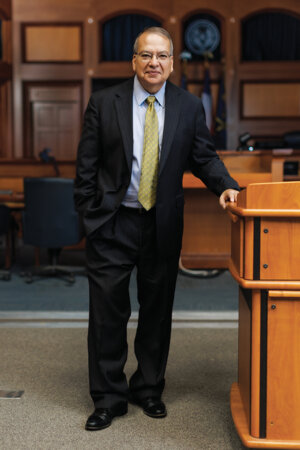
Rodriguez, J.D., Practicing Faculty and Distinguished Visiting Jurist-in-Residence, spoke on Emerging Trends in Litigation Use of AI. Former Assistant Professor of Law Niesel, J.D., who is now at the University of South Carolina Joseph F. Rice School of Law while continuing to teach St. Mary’s J.D. and M.L.S. students virtually, spoke on Strategies for Drafting Assessments in the Age of AI. Dawson, J.D., inaugural Associate Dean of Technology and Innovation at North Carolina Central University School of Law, discussed AI and Legal Education, which is the topic of her book, Artificial Intelligence and Academic Integrity.
“The presentations pushed me to increase my experimentation with AI,” Lampley said. “I started using ChatGPT for personal things, such as writing an email or drafting a letter. I am not using it for legal research, but I’m dabbling with it in class. There are times when students are doing group work, and I tell them to use AI to fact-check.”
The speaker series showed the faculty real examples of students using AI, so they must address it, she added.
“In the 2025-2026 academic year, we need to continue working on how to incorporate it in a way that preserves academic integrity,” Lampley said.
Rodriguez, a U.S. District Judge in the Western District of Texas, teaches E-Discovery and Digital Evidence to second- and third-year J.D. students at the School of Law.
“In these courses, I am introducing actual vendor tools that are supplied to me with traditional and AI-enhanced tools,” he said. “I have my students doing real-world exercises as if they were new associates identifying responsive documents.”
In Spring 2025, Rodriguez taught a course called Emerging Technologies and the Law for the first time.
“This class included an introduction to AI with discussions about cybersecurity concerns, breaches, cryptocurrency and blockchain technology,” he said. “While we are discussing AI, we must make sure we are always emphasizing the basics of good logic and good arguments. They must learn legal writing. They can learn to use AI tools to enhance and refine their first drafts.”
Legal writing lessons
Melissa Shultz, J.D., St. Mary’s Law Assistant Dean for Legal Writing, agrees that students must develop legal writing skills in school. All first-year J.D. students take a yearlong legal writing course, which she and nine other faculty members teach.
“From a big picture standpoint, there is a natural tension when it comes to using AI in a 1L classroom,” she said. “This is partly because they do not allow AI to complete the bar exam. The other reason is that AI is pretty fallible, especially in the legal context, so students have to develop the skills necessary to do lawyering tasks without AI in order to check AI.”
During the first semester of legal research and writing, students are prohibited from using AI, except for Grammarly, a non-generative AI grammar checker.
“We allow them to use AI to help them with their research,” Shultz said. “We talk about how to use it from a research standpoint. They don’t use it beyond that.”
“Students have to learn the skills first and later learn how to use generative AI tools in their careers.”
— Melissa Shultz, J.D.
However, AI must be integrated into the curriculum because attorneys will use it, she said.
“It is going to be important for practice,” Shultz said. “Students have to learn the skills first and later learn how to use generative AI tools in their careers.”
In the spring semester, first-year J.D. students are encouraged not to use AI to research and think through which cases to use for their arguments, she said. After students turn in their briefs, they put their statement of facts into ChatGPT or LexisNexis or Westlaw’s generative AI component.
Shultz said the students then see what kind of brief AI creates, depending on how they word the prompt.
“At this point, the students already deeply know the law,” she said. “They are able to use their high-level analytical skills to review the AI-generated brief.”
AI and criminals
Mason Clark, J.D., Assistant Professor of Law, arrived at St. Mary’s Law in August to begin the Fall 2025 semester. With a joint J.D. and M.S. in Cybersecurity, Clark was a data privacy and cybersecurity attorney in Indiana.
Clark said after seeing the use of AI by criminals, he knew when he entered academia, he would have to incorporate AI into his privacy and cybersecurity courses and his criminal law and procedures courses.
“Our students are already using it, and it is our responsibility to help show them how to use it effectively and to identify risk,” he said. “Students need to know ChatGPT hallucinates. Students know the famous cases of attorneys who use ChatGPT in court and cite fake cases.”

Students don’t understand that AI hallucinates context, he said.
“AI will take quotes out of context,” Clark said. “In addition, people in and out of law understand that prompting is very important for ChatGPT to give them what they want.”
As someone who recently arrived on campus, Clark said St. Mary’s Law has a reputation for being bold when it comes to legal education, highlighting the nation’s first Online J.D. Program accredited by the ABA.
Clark said it is vital for law students to be taught how to use a tool like AI while being guided by ethics, morals and what the law shows is right.
“AI will not be able to think for you when you are standing in front of a judge, and he asks you to explain why your defendant is not guilty,” he said.
In class, this former privacy counsel will teach students about the different risks companies may face using AI and the use of generative AI in cyberattacks.
“I also try to help students think about privacy and cyber risks when they have legal careers,” he said. “By teaching AI from a pedagogical standpoint, we are setting up our students to be leaders in the workforce by understanding
AI’s capabilities.”
Jena Martin, J.D., Professor of Law, said that while she was initially against AI, discussions with her teaching assistant and other law students revealed that students are using AI for everything they do.
“I have to make sure what we are teaching them about AI is relevant, and we are teaching them to use it responsibly,” said Martin, Katherine A. Ryan Chair for Global and International Law. “The challenge for me is that one of the courses I teach is on the bar, and they can’t use AI when they take the bar. They have to learn the material.”
Martin said she is researching AI in relation to regulations and the law. Her research compares the regulatory bodies in Europe to those in the United States, as well as studies data privacy laws and the implications of algorithms.
“In just the last two years, AI has become ubiquitous,” she said. “As regulators and legal authorities, we have to catch up. That is what I hope to do with my research — just catch up and bring people along with me.”
AI symposium
Recent graduate Natalia Jasso (J.D. ’25) recalled starting law school and getting access to online legal research platforms LexisNexis and Westlaw, which didn’t have AI components at the time.
“By my graduation, both have proprietary software, document drafting powered by AI and the ability to upload documents and have them summarized with AI,” she said. “It is very fast-moving and will affect everyone in every aspect of the legal field.”

Jasso is using her knowledge of the law as a clerk for the Hon. Christopher G. Bradley, J.D., U.S. Bankruptcy Judge in the Western District of Texas, for a year in Austin and then clerking for the Hon. Marina Garcia Marmolejo (J.D. ’96), a U.S. District Judge for the Southern District of Texas, for two years in Laredo. A Jurist-in-Residence at St. Mary’s Law, Garcia Marmolejo founded the St. Mary’s clerkship mentorship program.
In her third year at St. Mary’s Law, Jasso served as Editor in Chief of the St. Mary’s Journal on Legal Malpractice and Ethics. As soon as she was selected as editor, Jasso said she decided the journal’s 2025 Ethics Symposium would concentrate on AI.
“Since attorneys can earn continuing legal education credits at the symposium, I wanted to make sure that local attorneys would have the opportunity to learn about AI, how it should be used and how it shouldn’t be used,” said Jasso, a 2025 St. Mary’s Presidential Award Recipient.
Symposium speakers came from across the United States. These national thought leaders discussed topics ranging from AI being an impetus to amending the ABA Model Code of Judicial Conduct to ethical considerations for the estate planner with AI.
Jasso said the symposium was well attended by local judges and attorneys.
“I was surprised by the feedback we received; people wanted more on AI after they had a whole day of it,” she said. “While people are apprehensive about AI, it is something we have to learn about. We must double and triple-check it. AI is a tool we can use that is not going away.”