
Approver(s):
Authorizes Release:
Responsible Area:
Review Cycle:
Last Review:
Related Policies and Additional References:
St. Mary’s University provides the opportunity for resident students, who complete and submit the appropriate documentation to have an emotional support animal (ESA) in University-sponsored housing facilities. An Emotional Support Animal (ESA) provides therapeutic benefit through its presence to an individual with a documented disability, where that benefit alleviates one or more manifestations of the disability, and is permitted only within approved university housing. Emotional support animals may be approved as reasonable accommodations in a university under the Fair Housing Act and Section 504. An ESA is not a pet, nor is it considered a service animal under the Americans with Disabilities Act. The San Antonio Code of Ordinances, Chapter 5 – Animals, prohibits keeping certain animals and species within the City of San Antonio, including, but not limited to: monkeys and other non-human primates, wolf hybrids, coyotes, foxes, exotic cats, bears, skunks, raccoons, miniature Vietnamese pot-bellied pigs, poisonous reptiles, crocodiles, and related species.
Resident students must review the guidelines outlined herein and submit the information requested, including completing the attached ESA Form to the Office of Student Accessibility Services, before bringing an ESA on campus.
Once the documents are completed and submitted, staff will review the information provided and contact the student about the next steps.
Emotional Support Animal Documentation
- The credentials of a reliable third-party health care professional.
Documentation should be typed and submitted on official letterhead by a qualified health care professional who is licensed in the area for which the diagnosis is made and who is licensed in the student’s home state or in Texas.
The provider must have an established ongoing therapeutic relationship with the student. An established therapeutic relationship is defined as a relationship in which a client, under the professional counseling services of a licensed mental health provider, has engaged in assessment, treatment, or therapeutic intervention over a reasonable period of time, with the expectation of continued sessions, subject to confidentiality and professional standards, and not yet formally terminated. Their name, title, specialty, license or certification credentials, license number, and provider’s contact information must be included on the documentation submitted to the Office of Student Accessibility Services.
- Current documentation.
Documentation for a mental health or psychiatric condition(s) should be completed within the last year. Please include a description of the diagnostic tests, methods, and/or criteria used, including specific test results and the examiner’s narrative. - A diagnosis of the disability or disabilities.
The use of DSM-IV-TR or DSM 5 diagnosis code criteria and a narrative from the provider is necessary. - In addition to the clinical letter, the reliable third party must answer the questions on the ESA form (linked below).
Note: There are individuals and organizations that sell ESA certification or registration documents online. These documents do not convey any rights under the ADA.
Conditions for Keeping an Emotional Support Animal in University Housing
- Disruption: The partner/handler of an ESA that is unruly or disruptive (e.g., barking, bringing attention to itself, running around, aggressiveness towards others) may be asked to remove the animal from university facilities. If the improper behavior happens repeatedly, the partner/handler may be told not to bring the animal into any university residence hall until the partner/handler takes significant steps to mitigate the behavior. Mitigation may include, but is not limited to, muzzling a barking dog or refresher training for both the animal and the partner/handler.
- Ill Health: ESA that are ill should not be taken into public areas. A person with an ill animal may be asked to leave university residence halls.
- Registration Requirement: All ESA must be approved by and registered with the Office of Student Accessibility Services. Failure to register or maintain an ESA as required above may subject the partner/handler to fines or withdrawal of permission for the animal to remain in University housing.
- Submitting False Information is a Violation of St. Mary’s Code of Student Conduct:
Providing false information to obtain approval for an ESA will be treated as a violation of St. Mary’s University Code of Student Conduct. Violations will be reported to the Office of the Dean of Students, and could result in disciplinary action.
Emotional Support Animal Form (print and complete)
This form is to be completed by a qualified health care professional who is licensed or certified in the area for which the diagnosis is made and who is licensed in the student’s home state or in Texas. Attach the completed form to your clinical letter and submit it to the:
Office of Student Accessibility Services
St. Mary’s University
One Camino Santa Maria
San Antonio, Texas 78228
Phone: (210) 431-5080; Fax (210) 431-6706
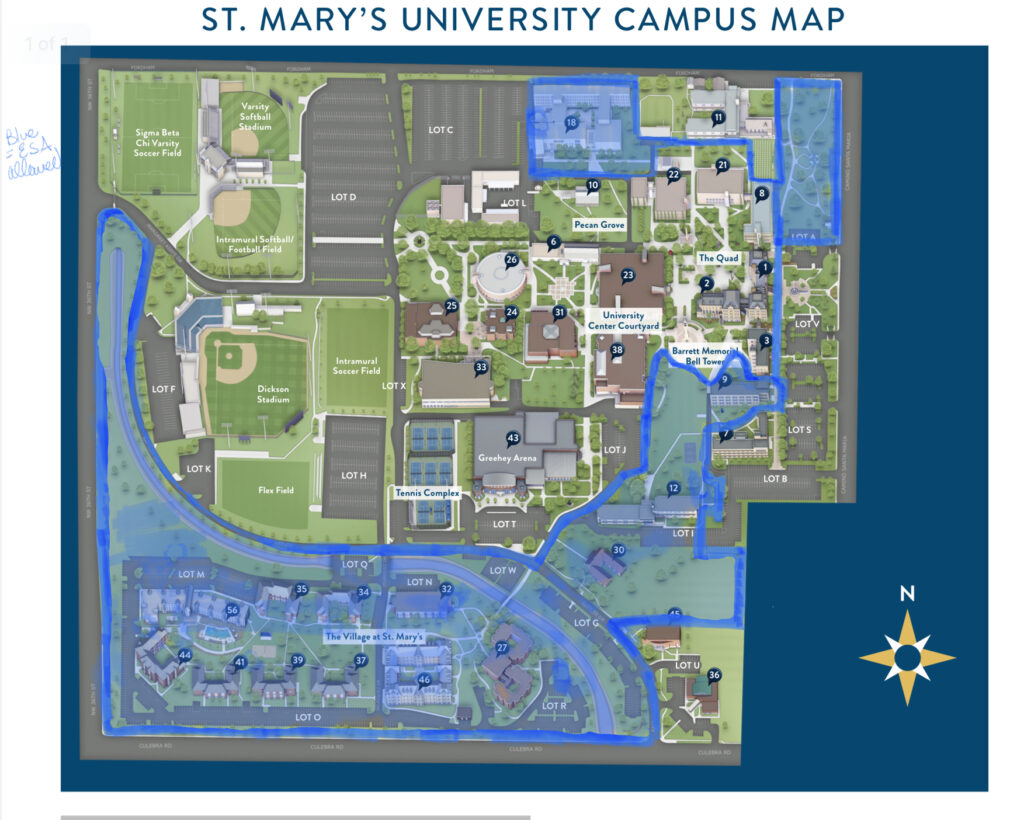
Emotional Support Animal Campus Map